
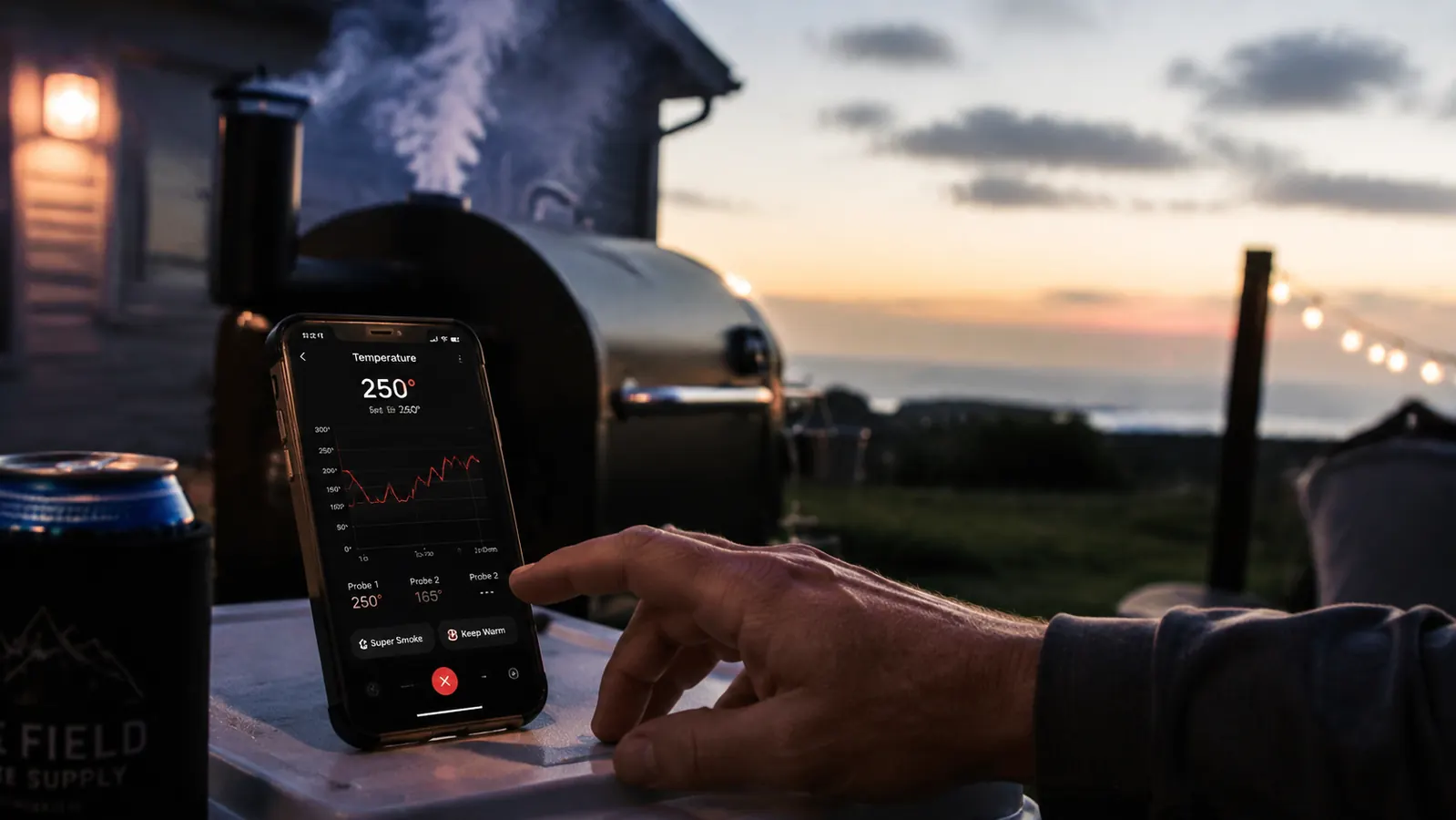
Every wireless thermometer review starts the same happy way. A smiling cook holding up a phone, a clean bell curve, a brisket sliced at 203 while everyone at the table claps. Nobody shows you the other ten seconds of owning one. The kitchen door clicks shut behind you and the graph on the phone goes flat. You walk back out to the deck, certain dinner is ruined, and the smoker is fine, the smoke is fine, and the MEATER Plus has simply decided it does not want to talk through two walls anymore. I know that exact feeling, because it happened to me a dozen times last spring before I learned where this probe actually belongs in a cook.
Six months and more than forty could later, here is the honest version I wish someone had given me. I work in IT, so a confident Bluetooth sticker does not impress me, and the MEATER Plus is a Bluetooth thing with a very confident sticker. It quotes 165 feet of range, which assumes no walls, no steel smoker body between the probe and your phone, and no belt buckle sitting between you and the signal. Once you accept that the realistic range is closer to half the sticker inside a normal house, this probe does its job about as well as anything I keep by the grill. This is the review I would hand myself on the day the box arrived.
The Quick Verdict
The best leave-in wireless probe I have used once you accept the real Bluetooth range and learn the ambient sensor's moods. It does not hold a 4.3 average across 48,000 reviews by accident. It also does not deserve a perfect five from anyone.
Amazon Check Today's Price →The Probe I Trust With a 14-Hour Cook, Annoyances and All
Forty smokes in, this is the leave-in probe I reach for on long cooks. The range bites, the app panics at the stall, and I would still buy it again tomorrow. Check today's Amazon price, then read what I said about the one-star reviews before you commit.
Amazon Check Today's Price on Amazon →How I've Used It
My ground rules were simple. The probe goes into the thickest part of the meat until the little ring disappears into the flesh, which leaves the ambient band out in the open air, and the charging block gets placed so it faces the house. I run an 18.5-inch Weber Smokey Mountain on a covered deck in coastal humidity, and a 22-inch kettle for hot-and-fast work. Every cook since the end of March has been logged in the MEATER app, so I can tell you about a full season of brisket, shoulder and rib cooks without padding the numbers.
The muscle memory formed faster than I expected. Pork loins and large chicken thighs on the kettle want fifteen minutes of setup and then run themselves. My standard shoulder, about eight pounds, goes on at seven in the morning with the alarms armed at the target, and I can split firewood, tear out a flower bed, or ride the gravel loop and come back at seven and meat parked exactly where it should be. The lid does not open between the charcoal lighting and the wrap for fill. That sentence alone has done more for my weekend sanity than any flavor tip.
It was not all smooth in the first month. One weekend the ambient band ended up buried under a fattier cut, and the app spent the entire first hour lecturing me about a 118-degree pit while the smoker clearly hovered around 244 by the grate. I learned to check the probe's seat the way I check my seatbelt: before the lights, not after the crash. That single habit removed more aggravation than every firmware update the app has sent since, and it is the one tip I would hand a first-time owner in minute one.
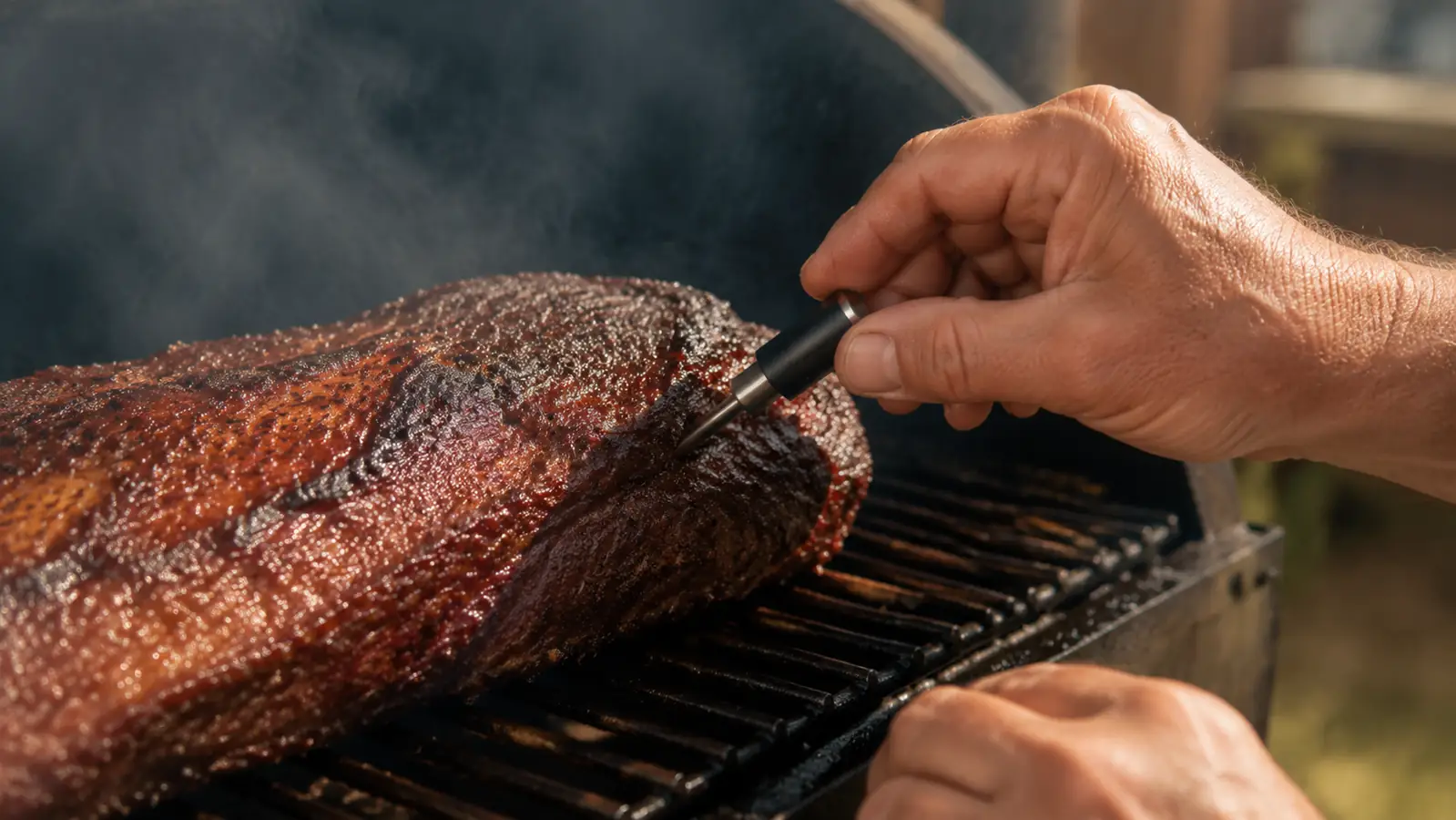
The real trust test came on a thirteen-pound brisket in July, my first overnight cook of the season. I set the MEATER app at 203, went inside at eleven, and let the alarms take the night watch. The phone woke me twice, once when the stall finally broke and once when the meat slid to the pad, and the brisket came off at quarter to seven the next morning with a bark I have never beaten. That is the honest reason this probe earned its spot on the shelf.
The Honest Numbers: 4.3 Stars Across 48,000 Opinions
I have read a few hundred of those 48,000 reviews, with a deliberate stop in the one-star section, because that is the only honest way to shop for anything. The complaints cluster in two places: the Bluetooth range and the app. Almost nobody hollers about accuracy. That matches my own experience exactly, and it tells you what the actual product is before you spend money on it.
Accuracy is the thing you are buying, and it holds up. At hour twelve of a long cook the MEATER Plus read 198 while my wired backup probe read 198, and at hour nine, on a rack of trimmed spare ribs, both said 191. Two independent tools agreeing inside one degree across an eleven hour window is the real difference between a gadget and a workhorse. That agreement at midnight is the entire reason I trust this thing.
Here is what the star count hides. A 4.3 average over tens of thousands of ratings means a lot of two and three star cooks liked the idea but not their specific copy, and a meaningful share of those complaints name range or a flaky reconnect as the max. Nobody buys a four star product expecting range math to become the whole argument. The honest move is to walk in already knowing the range is real, not a feature to be discovered at 11 pm on the night of your holiday brisket.
What Nobody Tells You About the Bluetooth Range
Here is the honest range map, measured by walking. Standing at the smoker with the phone in my hand, everything the box says about 165 feet is true, the link is embarrassingly solid. Step inside the kitchen door with one wall behind you, a realistic forty feet of story, and the curve started freezing twice per cook during my first month. Head upstairs to the front office, and the app loses the reconnect about half the time.
The fix is geometry, not a new device. Point the charging block toward the house, keep your phone on the side of your body that faces the smoker, and on overnight cooks leave the phone somewhere with a clear path to the porch before you set the alarm. The MEATER Plus is a stay-near-your-pit tool, and that is the honest category it belongs in. Nobody prints that on the sticker, because nobody wraps well with a disclaimer.
One more range note that surprised me. Out by the fire pit at the far end of the yard, with the smoker in clear view, the link held near the full 165 feet with only a few bushes in the way. The worst drop I logged all season was not distance. It was a stack of small sins: phone in my back pocket, kitchen door closed, a wall of plumbing between me and the grill. Change any one of those and the connection came back within a minute and rebuilt the whole curve, without losing a point, because the probe samples history on its own.
The Ambient Probe Reads the Meat's Microclimate, Not Your Whole Pit
The second sensor sits inches from the meat, and for the first hour of a smoke it reads the air right at the meat's surface. A cold thirteen pound brisket is a giant heat sink. Drop it into a 235 degree smoker and that sensor will read thirty degrees low for the first sixty minutes while the air above the grate is exactly where it should be. The classic mistake, and I made it, is cranking the vents to fix a reading that was never wrong to begin with.
Once the meat warms, the ambient band turns honest, and by hour six it is the number I check first. Between those two phases it is a trend to watch, not a gauge to trust for exact numbers. If you need a precise grate temperature right now, keep a cheap oven thermometer clipped to the grate for the first hour. That little clip cost me three dollars and has stopped more overcorrection than any alarm in the app.
The other ambient trap is thin cuts. On chicken thighs or a whole pork loin there is not enough meat to hide the band the way a brisket does, so the sensor drifts toward the pit air and stops acting like a meat probe at all. Bury it by accident and you get a reading that looks visibly broken. I keep a mental ruler for each cut now: roasts get the full insert, and anything under two inches thick goes in sideways.
The App Is the Best Part and the Worst Part, and Both Show Up at the Stall
Somewhere around hour five the brisket parks at 157 or 158 and sits there for ninety minutes. That is the stall, and the app reacts the way honest math reacts to a flat line: it panics. The remaining time estimate swings from four hours to seven and back inside a single stall, and the first time you see that you will think the probe is dead. It did not die. The meat is doing the meat thing, and the app is just bad at pretending otherwise.
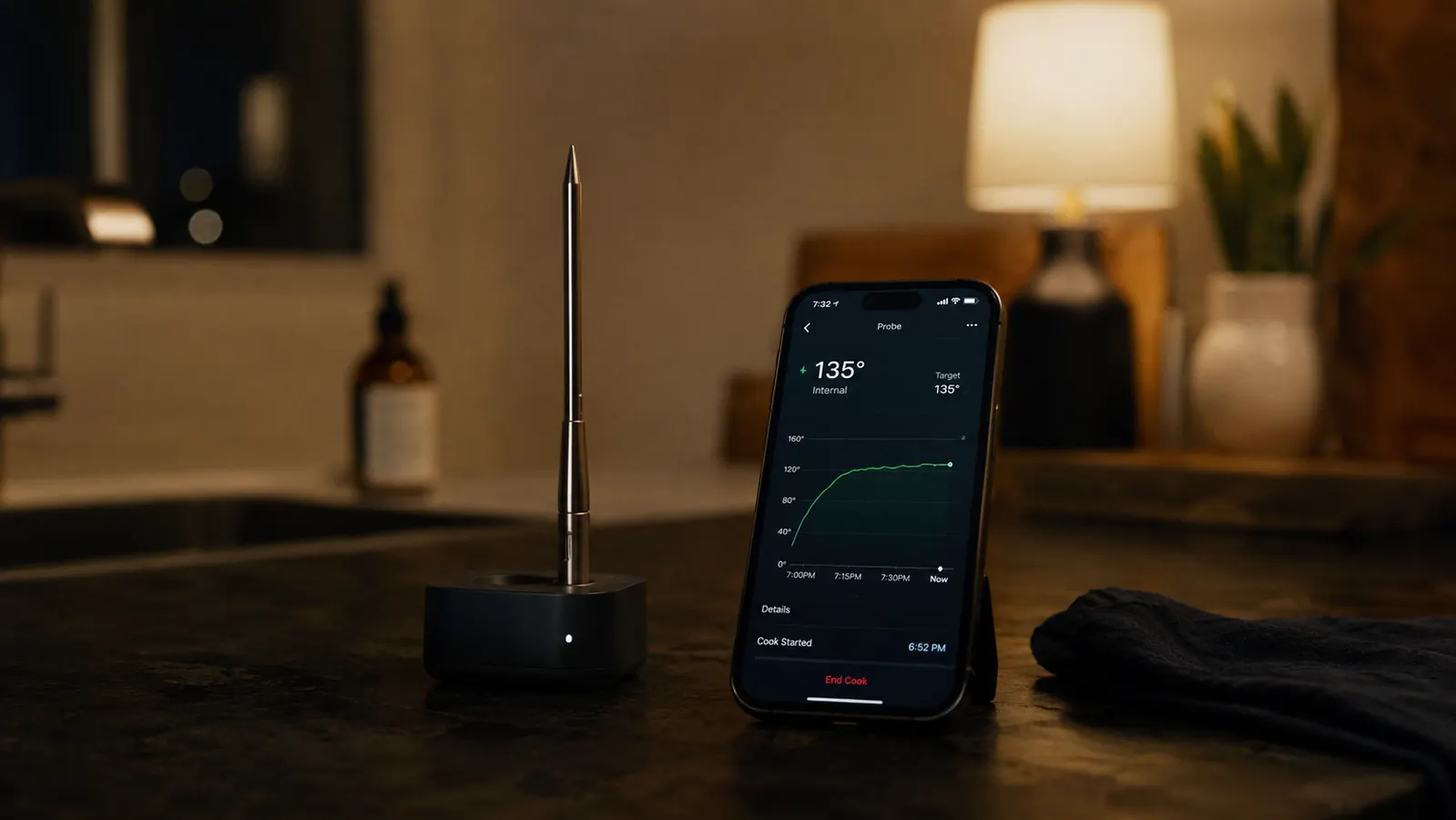
Outside the stall, the app is the reason I stayed. The live curve shows the whole cook on one screen, the alarms are loud enough via a closed bedroom door, and the guided modes got me through a first whole turkey without a single trip to Google. The honest side is that this thermometer has no screen of its own. No receiver, no display, no local readout. It is the probe and an app, and if that is not how you want to live, no review should talk you into it.
Pairing deserves a word. The first connect a couple times needs a phone restart, and the app updates itself far more than any other kitchen gear I own combined. None of it is hard, and an IT guy raises an eyebrow, but a weekend cook who wants dinner rather than a project does not expect a thermometer to ship with a firmware routine. Set that mental model on day one and the tool stops surprising you in week two instead of week twelve.
The MEATER Plus read 198 on the nose at hour twelve, against the wired backup probe's 198. That is the number you are paying for, and it genuinely holds up.
What I'd Buy Instead, Honestly
If the idea of a phone standing between you and a thirteen pound brisket feels wrong, the honest alternative is a wireless set that carries its own receiver screen. The probes are cabled into a base unit you carry, so the range story is completely different and there is no app to argue with. You give up the graphs, the saved history, the guided presets, and the clean single-probe trick, and for a casual weekend cook that can be a perfectly fair trade.
Need four probes and a longer leash? That is the block model with more ports. Need Wi-Fi status from the grocery store? That is the Pro line. I have not cooked with ether of those, and I do not review what I have not cooked. What I know from a standard smoke is where the MEATER Plus sits: one probe, one phone, one smoker, and you inside range of all three. That is the entire honest description worth giving anybody before they buy.
I still keep the wired backup probe clipped to the grate of a long cook, not because the MEATER needs watching and because that is the insurance. Two independent readings across a thirteen hour cook are cheap sanity at midnight. It has saved one afternoon and the value of the appliance is above what a stick thermometer could do.
What I Liked
- Holds accurate at hour twelve; it exactly matched my wired check probe at the finish
- No cable through the lid, so the smoker stays shut and the gasket never gets crushed
- Saves a full graph and log of every cook, a record I used to keep by hand
- Alarms fire on the phone and genuinely wake me through a closed door
- Runs a full season on one charging block with a simple after-cook habit
Where It Falls Short
- Real Bluetooth range is about half the 165-foot sticker once a wall joins in
- The app's remaining-time estimate swings wildly through the stall and scares first-timers
- The ambient sensor runs low for the first hour against a cold roast, and it is easy to over-react
- No receiver, no screen, no WiFi; if the phone dies, so does the system
Who This Is For
Buy it if you smoke at home, on weekends, if keeping a phone within reach of the pit is a normal part of your day, and if your whole goal is opening the lid as rarely as physics lets you. It is for the cook who has already watched a wired cable crush under a lid one too many times, who does not mind the two habits it asks for, charge the probe after every smoke and point the block at the house, and who wants the curve and the results more than a louder beeper on the porch.
Who Should Skip It
Skip it if your smoker lives on one side of a big house and you plan to watch from the other, because you want the WiFi version or a receiver you can hear. Skip it if an app is a deal breaker. And skip it if you live on hot and fast steaks, because leaving a probe in a twelve minute sear is the wrong tool; that is where an instant read wins. The MEATER Plus is excellent inside an honest box, and a poor fit everywhere outside it.
My Honest Verdict After 40 Smokes: Plan Around the Range and You'll Be Glad
The MEATER Plus is the leave-in probe I reach for on long cooks, caveats and all. It earned space on my shelf this season, and it is the first thing I would rebuy if it died tonight. Check today's Amazon price, and do what I did, read the one stars reviews before you commit.
Amazon Check Today's Price on Amazon →