
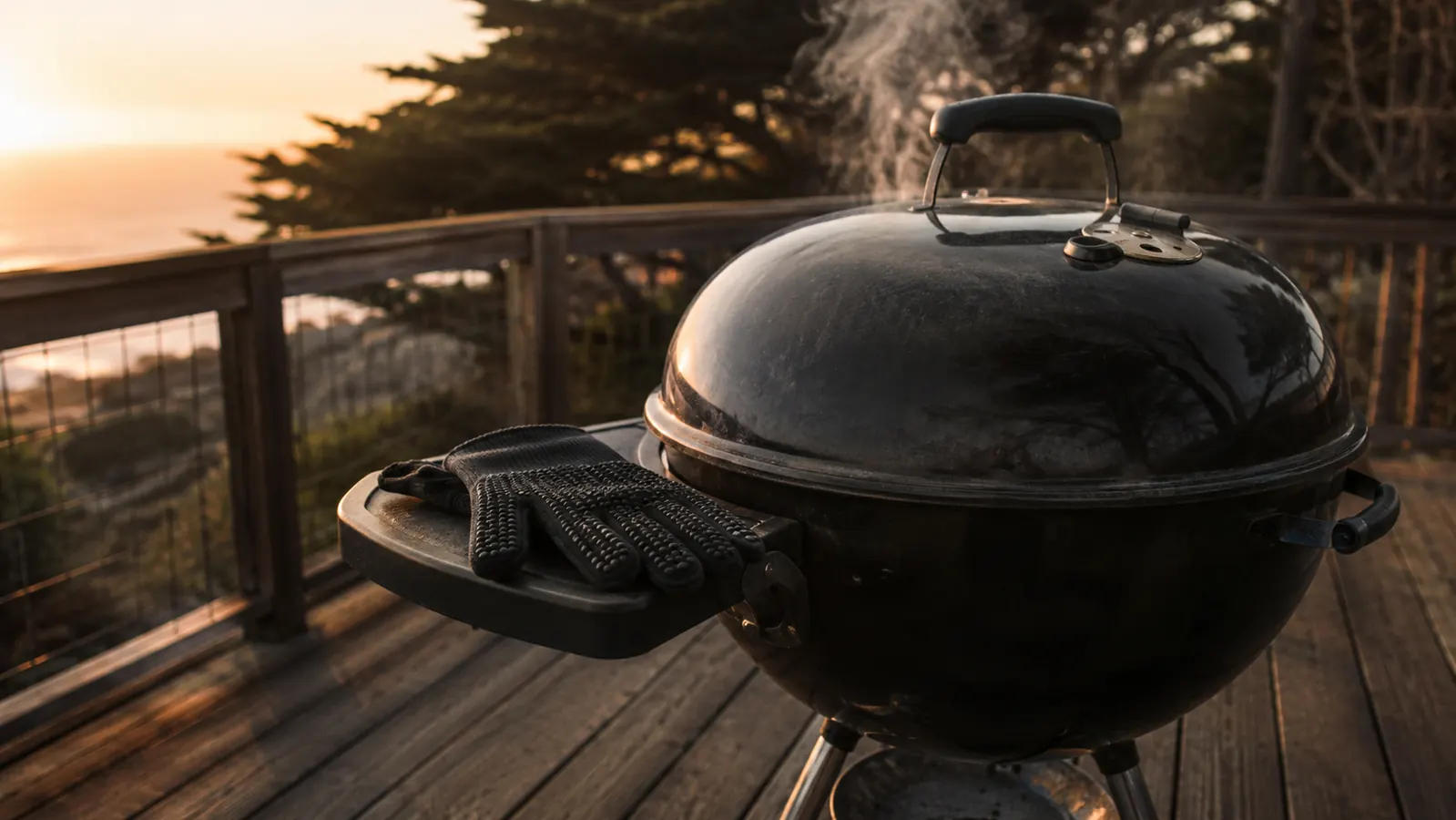
Cooks are won and lost in the two seconds you reach across a hot grill. Mine went sideways on a Saturday in early June, three weeks into the season. I went to grab the lid of my 22-inch charcoal kettle with a cloth oven mitt, caught the edge of the cooking grate, and watched that cotton start to smoke before I could pull my hand back. The mitt went in the trash and my index finger wore a blister for a week. Cloth mitts are fine for pulling a casserole out of a 350-degree oven. They are not fine for a charcoal fire that has been running at 500 degrees all afternoon.
That burn sent me down a research hole, which is how I relax. I read the EN407 heat-protection standard, watched pitmasters yank whole pork shoulders off a smoker bare-handed, and tested a cheap silicone mitt that turned my hands into paddles. The fix that stuck was a pair of Grill Armor Gloves, bought in May, and I ran about sixty cooks on the kettle and the bullet smoker with them between Memorial Day and Labor Day. None of the research changed the core problem, which is that grilling asks your hands for three things at once: stay unburned, hold a fourteen-pound brisket without dropping it, and keep enough finger feel to work a thermometer probe or a foil wrap. Grill Armor Gloves were the answer on all three.
The Quick Verdict
After sixty cooks the Grill Armor Gloves are the first thing I reach for when the grate comes off, with one honest caveat: 932 degrees is a lab rating, not a license to grab a live coal.
Amazon Check Today's Price →One Pair of Gloves Ended a Decade of Singed Wrists
I used these on every cook from Memorial Day through Labor Day, including the August brisket I pulled in foil at ten at night. If that sounds like your backyard, check today's price on Amazon before you burn another good mitt.
Amazon Check Today's Price on Amazon →How I've Used It
A quick rundown of my setup so the rest of this lands. I'm Robert, I'm 58, I work in IT, and when I'm not at a keyboard I'm on a bike or standing over smoke. My main cookers are a 22-inch Weber kettle and a bullet smoker I've owned for nine years. Most weeknights are a two-hour chicken or steak cook, and long weekends are for pork shoulders and the occasional brisket. The gloves got worn for all of it, not just the part that makes a good photo.
The jobs split into three buckets. First is grate work: lifting the hot grate off the kettle, shaking ash loose, sliding a cast-iron pan across the bars, nudging a drip tray back over the coals. Second is smoker work: opening the lid mid-cook to spritz a shoulder, rotating a brisket on the rack, and the big one, lifting a foil-wrapped pack off the grate at the end of a long day. Third is the unglamorous stuff that nobody photographs: moving a hot water pan, clearing a clogged vent, and in late September, feeding the fire pit and dragging a hot log into place.
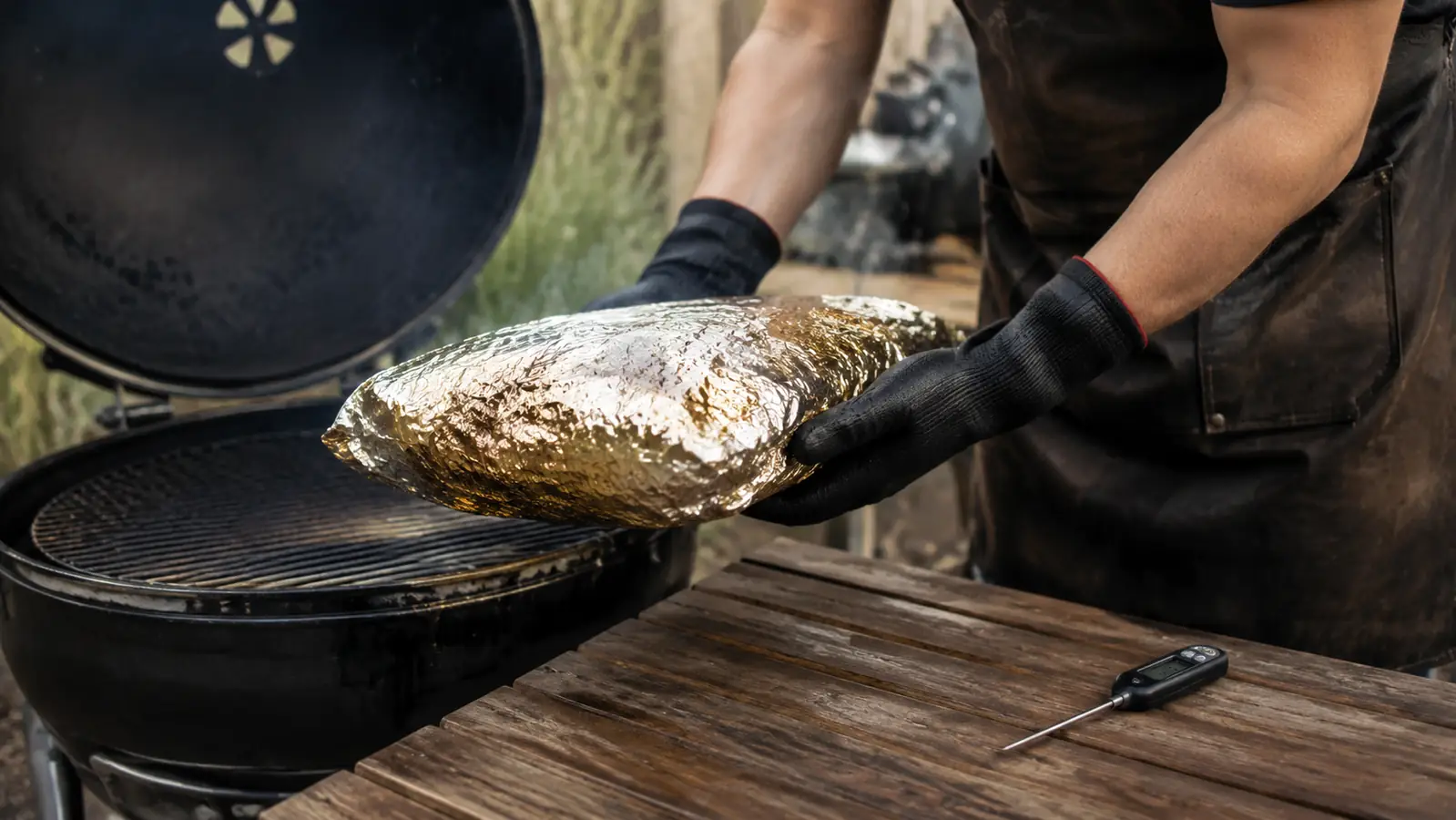
The moment I keep coming back to happened in August. A fourteen-pound brisket came off the kettle at ten at night, wrapped in foil, 203 degrees internal after an eleven-hour cook. I grabbed it with both gloved hands, carried it to the cutting board, and felt nothing through the palms. Then I set the gloves down on the deck for pit and carved for ten minutes while the foil itself was still too hot for a bare finger. That single stretch sold me harder than any spec sheet ever could.
One July weekend I ran a nine-pound pork shoulder for nine hours straight. The gloves came into play three times: once to spritz the bark, once to wrap in paper, once to lift the finished shoulder onto a rest oven-rack. Three contacts across a full day, and the pair handled all three without complaint. That is the kind of unremarkable reliability a tool needs to earn a permanent hook by the back door.
How Honestly That 932-Degree Rating Works Out
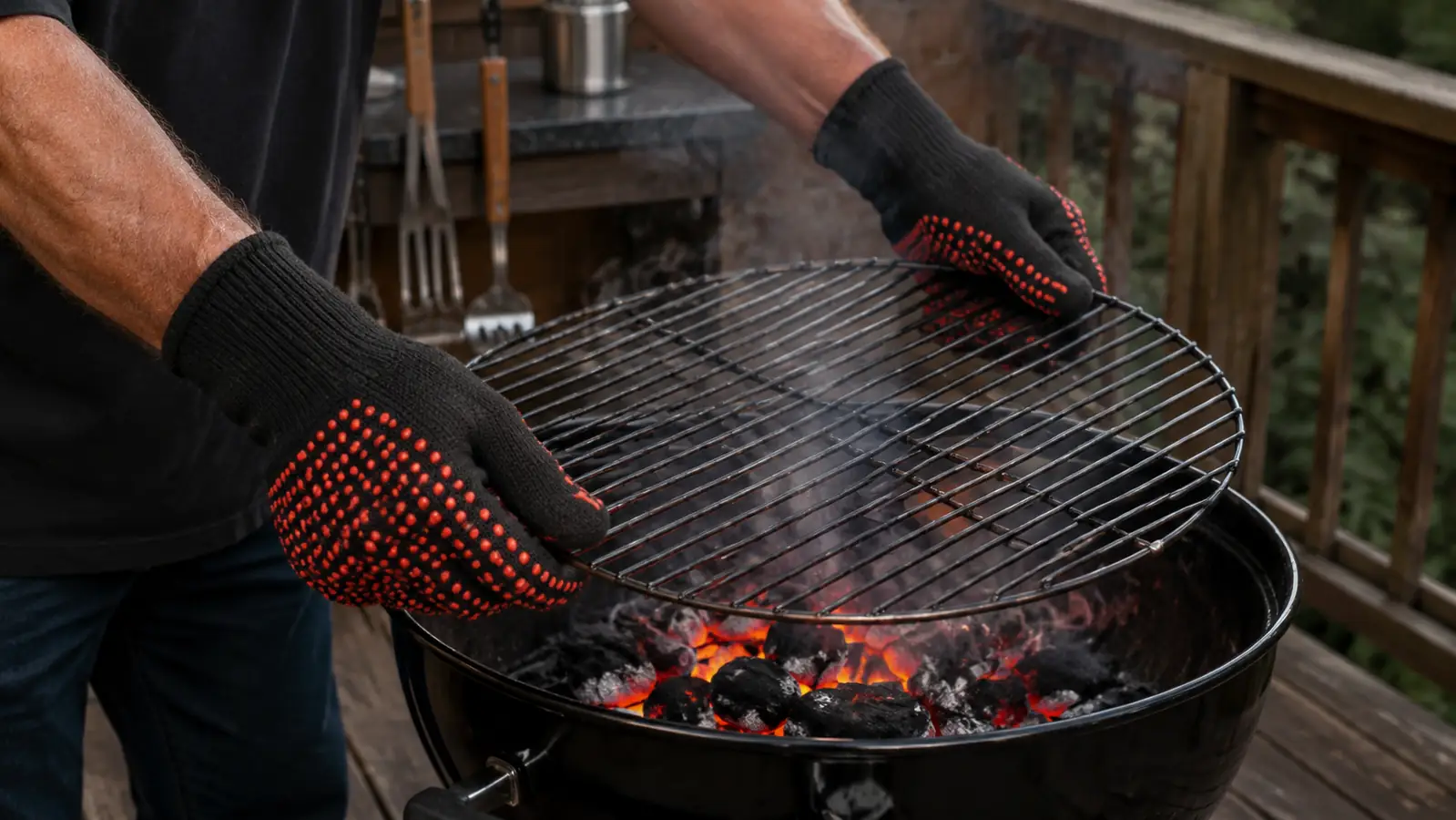
Here is the honest translation of the big number. These gloves carry an EN407 certification, which is a real European standard that measures how long a material blocks conducted heat under controlled test conditions. The 932 degrees advertised is the top-end claim with a short contact window. What that means in practice is a glove built for a quick grab of something extremely hot, not a license to hold a glowing grate while someone takes a photo.
The construction backs that up. The hand is wrapped in a cut-resistant knit, the same family of fiber you find in welder's sleeves, with a silicone grip molded onto the palm and fingers and a cotton lining against your skin. The fingers are actual fingers, not a mitten, and that is the whole difference between clamping a thumb and forefinger around a thermometer probe and trying to work your whole hand around a grate bar. The silicone is what keeps a slick foil-wrapped brisket from sliding out.
The cut resistance earned its keep faster than I expected. Grill brushes shed bristles, foil grows sharp edges after an hour over coals, and hot pans have corners. I am not juggling knives in these, but when a stainless skewer slipped off the rail this spring and grazed me on the knuckle, I knew the glove had made the difference between a flinch and a bandage.
I ran one controlled test in the name of science: grabbed the edge of a cast-iron skillet that had been sitting on the hot kettle and held for two seconds. No pain, no drama. It is real protection, not magic, and the border between those two is exactly where honest reviews live.
Now the part the marketing photograph hides. Sustained direct flame will eventually beat any fabric, and water is the other enemy: the cotton lining soaks up moisture, and a damp glove can conduct heat straight through. I learned that one evening reaching into a steamy kettle to reseat a foil pan. If your hands are wet, dry them before the grab, every time.
I lifted a foil-wrapped fourteen-pound brisket straight off a 300-degree grate in August and felt nothing through the palms. Minutes later the foil was still too hot to touch with a bare hand.
The Grip and the Dexterity Difference
The real argument for a pair like this over every mitt I owned before is the grippy palm and the separated fingers. Silicone dots run across the palm and down the bottom of each finger, and they bite into smooth metal and slick foil in a way cotton never does. I can carry a hot half-gallon pan one-handed without the death grip it used to take, which frees up the other hand for a spatula or the lid.
Dexterity is where cloth mitts and I always fought. A mitt gives you a thumb and a mitten, which means anything finer than carrying a pot is out. With separated fingers I can unzip a foil pack, work a probe into a roast, and manage a chimney starter without setting it down. The touch is not surgical, nobody is threading a needle in these, but it is enough movement to actually cook instead of just carrying things.
The one dexterity miss is anything that needs real fine feel, like pulling a pin bone out of a chicken leg, which still means taking a glove off. The material is thick enough that you lose the last bit of tactile feedback. That is the honest trade on 900-degree protection, and I am happy to make it at the grill.
How They Held Up Over a Season
Sixty cooks and about eight months in the shed between seasons. The durability verdict on the Grill Armor Gloves is genuinely good. The cut-resistant knit has no holes, no fraying at the cuffs, and no melted spots where a grease flare came past. The grip is still gripping, with the only visible wear at the thumb crotch, which is exactly where every grab lands. I wash them in cold water and lay them flat to dry, and they come out clean with zero shrinkage.
The honest bits. They smell like smoke no matter what you do, which I rate as a feature at a barbecue house. They are not waterproof, and the one care tip that cost me a lesson is to let them dry fully before they sit in a drawer, because a damp glove left folded smells like a wet dog that has been through a campfire. Give them an hour on the rail and they are fine.
The open cuff is the one thing I would change. A longer gauntlet that overlaps your sleeve would catch the odd ember and keep the draft off your forearm on a wet afternoon. It has never cost me a burn and it has never once made me reach for a different pair, but it is the honest gap in an otherwise well-built glove.
Alternatives I Considered
Before I settled here I worked through the usual suspects. Cloth oven mitts have no dexterity, go limp the second they get wet, and sing at grill heat, which is where this whole story started. Silicone mitts run waterproof and easy to wipe down, but they are stiff, they turn your hands into paddles, and trying to seat a probe through a roast while wearing some is a joke.
Welder's gloves are tougher than almost anything else and cheaper, but the lining marks up the first time you hold a warm packet, and wet leather conducts heat in a hurry. The nitrile-over-cotton combo that a lot of barbecue people swear by is excellent for a long session of pure meat handling, but there is no heat rating on the nitrile, so it does nothing for you near a grate.
I also looked hard at elbow-length smoker gloves. They are the right call if your whole world is one long brisket in a horizontal cabinet smoker. For my kettle-and-bullet setup, the wrist-length cut of the Grill Armor Gloves covers everything I actually land on and leaves me the finger feel to keep making the meal instead of just hauling hot metal.
I also handled one no-name hardware-store pair that cost about half as much, just to see. The knit was fine and the fit was sloppier, but the silicone slid on the first wet brisket, which is exactly the moment grip matters the most. Cheap gloves fail on the greasy grab, and the greasy grab is the whole job.
What I Liked
- Survived more than sixty charcoal cooks with no holes, fraying, or melted silicone
- Separated fingers give real dexterity for probes, foil wraps, and vent work
- Cut resistance is a daily bonus against grill brush bristles and sharp foil edges
- Silicone palm still holds a slick foil-wrapped brisket after a full season
Where It Falls Short
- 932 degrees is a no-contact number, not a coal-fondling permit
- Sustained direct flame will still cook your hand
- Open cuff lets the odd ember onto your wrist near the fire pit
- Fit runs snug, so size up if you have large hands
Who This Is For
If you cook on charcoal at all, even two weekends a month, you are the audience. Anyone who lifts a grate, rearranges coals, or has ever stood there waiting for a 200-degree piece of meat to cool down enough to touch the foil needs some. The same goes for anyone on their second ruined cloth mitt this summer, or who has ever held a grill brush in their teeth because both mitts were somehow missing.
It is also the right buy if you do any fire pit work at all, because the same dexterity that works a grate is exactly what you want when a log shifts and you need to reach in and fix it. And if you are the family cook tired of improvising with folded towels, these earn their spot on day one.
Who Should Skip It
Skip them if your kitchen work is a casserole and a pizza tray, because cloth mitts and silicone pot holders are cheaper and fine for that job. Skip them if you expect a 932-degree rating to let you hold a bed of coals in your hands, because it will not, and neither will the burn you collect trying. And if your hands run large, size up, because a glove that is too tight makes every grab feel like work.
The Pair That Earned a Permanent Spot by the Kettle
I rerouted a decade of ruined oven mitts into one set of durable gloves that handled a full season of grates, coals, and overnight breathers. Check today's price on Amazon and see if Grill Armor Gloves earn a permanent hook next to your grill.
Amazon Check Today's Price on Amazon →