
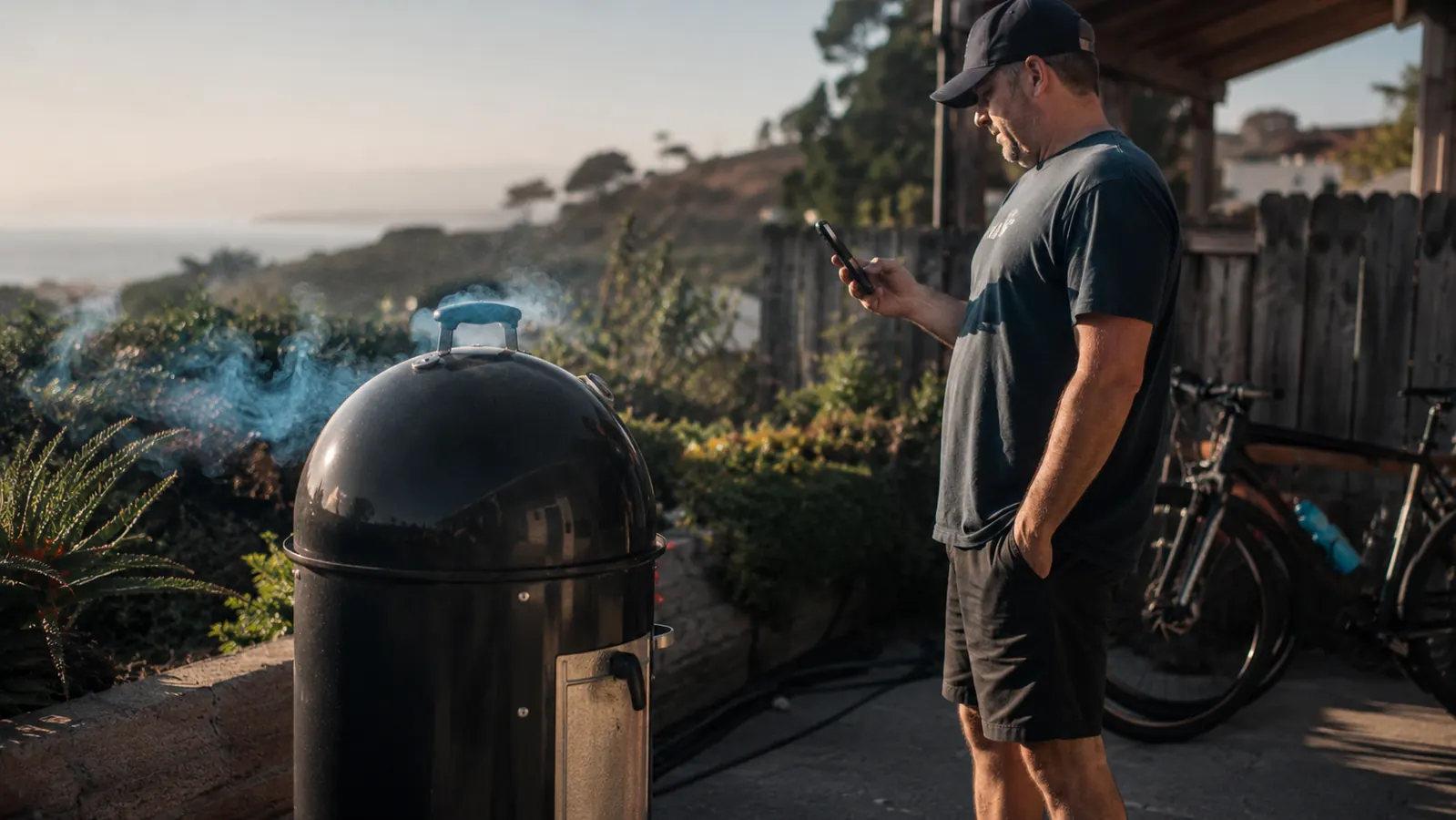
The most dangerous thing at my smoker was never the meat, the coals, or even the wind off the bay. It was me. I would walk out to my 18.5-inch Weber Smokey Mountain every twenty minutes, lift the lid to poke the flat with an instant-read probe, frown at a number that seemed lower than it should be, and drop the lid again while a plume of heat rolled off the pit. Every one of those opens dumped ten to fifteen degrees of chamber temperature, stalled the bark mid-set, and stretched a planned nine-hour cook into eleven. I owned the gear, the coals, everything but the habit.
The fix was not more patience. It was a way to see what was happening inside that closed drum without ever lifting the lid. I tried a wired probe once and the cable fought the lid seal on every close, chafing through in a season. A wireless leave-in thermometer with a meat sensor and an ambient sensor in the same stick, made by MEATER, is what finally broke the habit for me. The MEATER Plus spends the whole cook in the thickest part of the brisket, samples the air temperature just above the grate at the same time, and streams both numbers to the phone in my pocket. When I moved the phone to the kitchen window sill, it was the closest I have ever come to a hands-free cook. I still glance at the drum when I walk past. I just do not open it to learn anything anymore. Here is the exact workflow I run now, from the first coal to the foil.
The probe that stopped me from opening the lid
MEATER Plus is the wireless leave-in thermometer that reads your meat and the pit at the same time and puts both on your phone, with a charging base that stretches the Bluetooth signal to about 165 feet. It ended my lid-opening habit on the first brisket.
Amazon Check Today's Price on Amazon →Step 1: Get the pit stable before the meat ever goes on it
Most lid opens are fire maintenance in disguise. On a charcoal rig the first hour is when the temperature lies to you: the coals spike as they catch, sag as they settle, climb again, and only then start to hold. I used to correct every wobble by cracking the lid and staring at the grate like it owed me an answer. Now I let the WSM find its rhythm first. I bring it up with the bottom vents close to wide open, walk it toward my target, then set the vents and leave the lid alone for a full 45 minutes with the water pan full before the brisket even goes on.
Do the same on whatever you actually cook with. A gas or pellet rig needs fewer opens, but it rewards the identical discipline: lock the chamber at your target temperature first, then load the meat. A stable pit is the whole ballgame, because it changes what the probe is for. When the fire is settled and holding, the probe has one job, to track the meat, and your phone becomes a dashboard instead of a fire alarm. When the fire is not settled, every reading looks like an emergency and you will be back to cracking the lid before dinner.
Write the target down before you light anything. I keep brisket and pork at 250 on the WSM, and I do not let myself chase 245 or drift to 260. A fixed target makes a drift obvious. Without one, every number looks like a problem and the lid comes off out of pure uncertainty.
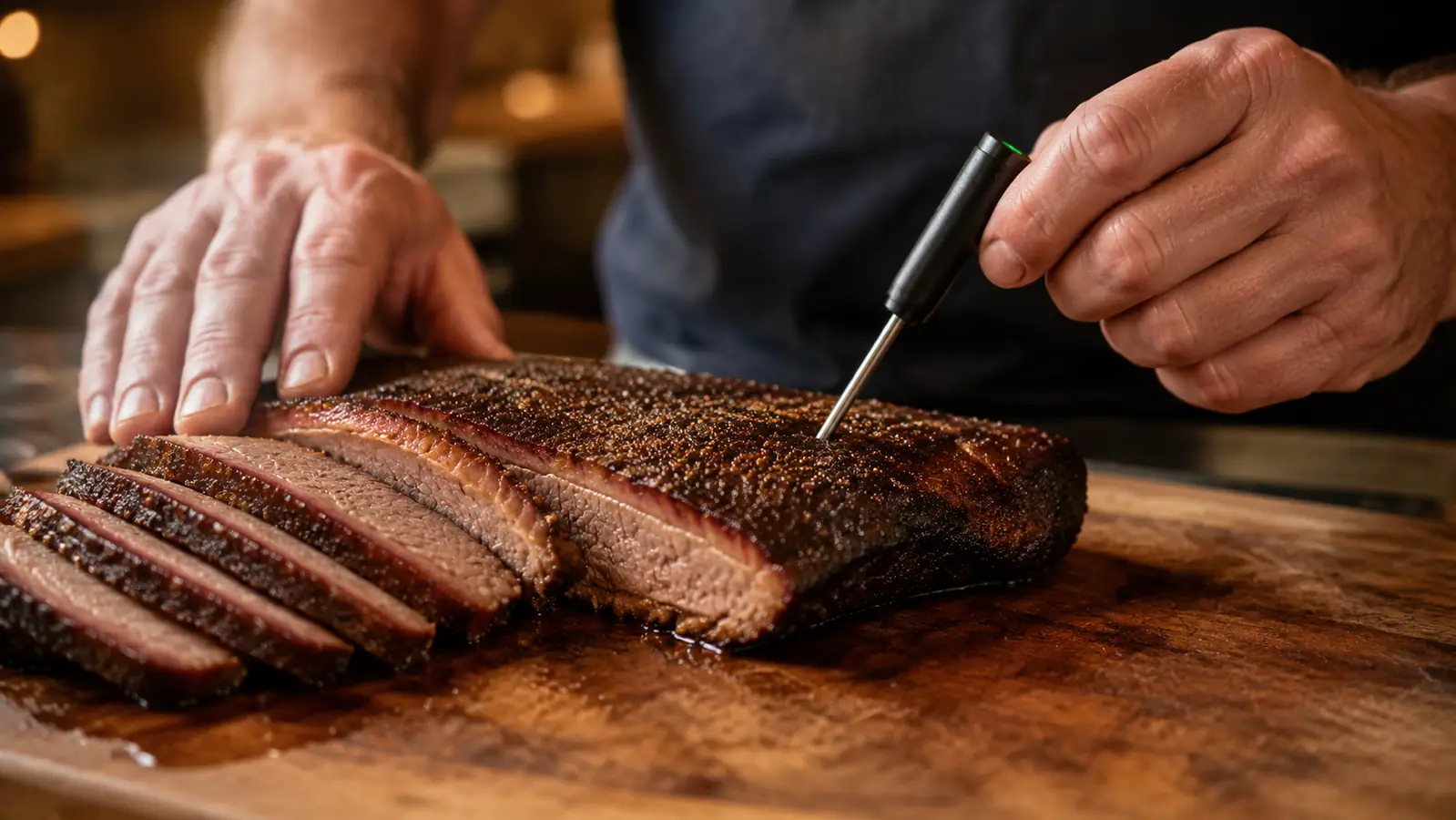
Step 2: Place the probe where the number means something
Meat temperature is not a fact, it is a reading from a specific spot, and the whole trick is picking the right spot. On a brisket I slide the MEATER Plus into the thickest part of the flat, angled so the sensor sits dead center of the muscle, clear of any fat pocket and clear of the deckle. A probe buried in a cap of fat will happily report a confident, useless number for six straight hours, and you will pull early or late on the strength of it.
What most new owners miss is that the MEATER Plus reads ambient temperature too, from a second sensor up near the exposed end of the same stick. That exposed end needs to sit in open air, roughly level with the grate, and it must not touch the meat. If it is tucked against the brisket, your pit reading runs fifteen degrees high and you will spend the afternoon opening the lid to fix a fire that is not off by anything. Seat it like you are taking the meat's pulse, not hugging it. A clean ambient read is the difference between trusting your eyes and trusting your phone.
Same logic on a pork shoulder or a rack of ribs: push into the deepest muscle, parallel to the bone when there is one, and keep the ambient end in moving air. The probe does not know what kind of meat it is in. It only knows the temperature at the sensor, so placement is what makes the number honest. Two or three smokes in, you will be able to seat these blind and trust what you get.
Step 3: Pair it, set your alarms, and prove the range before the smoke starts
The MEATER app walks you through pairing in about two minutes. You name the cook, tell it what you are cooking from its library of target temperatures and estimated times, and set your alarms. I set two on every long cook: one about fifteen degrees below my pull temp, just so I have time to walk outside, and one at the target itself. The whole point is that the phone does the watching so you do not have to stand in the wind watching it yourself.
Here is the step everyone skips: go stand where you will actually be during the cook, phone in hand, before the pit is even loaded. The MEATER Plus runs on Bluetooth, boosted to roughly 165 feet by the charging base, and Bluetooth cares about walls, brick and the metal box of a refrigerator. I keep the base on a patio table, never inside the cabinet, and I tested the alarm from the kitchen and from the bedroom window before I trusted it. Learning at hour six, mid-shower, that the signal dies at the back of the house is a terrible way to discover your range.
Once the cook is running, the app earns its keep in two quiet ways. It prints a running estimate of time left, and that number rewrites itself every time the stall bends the curve, which is the closest thing smoking has to weather forecasting. And it keeps the full history of the cook, so I can scroll back later and see exactly when the pit drifted and what I did about it. None of that requires me to move. On an overnight cook I check the whole picture from bed, set the phone face-down, and trust it until the alarm or morning, whichever arrives first.
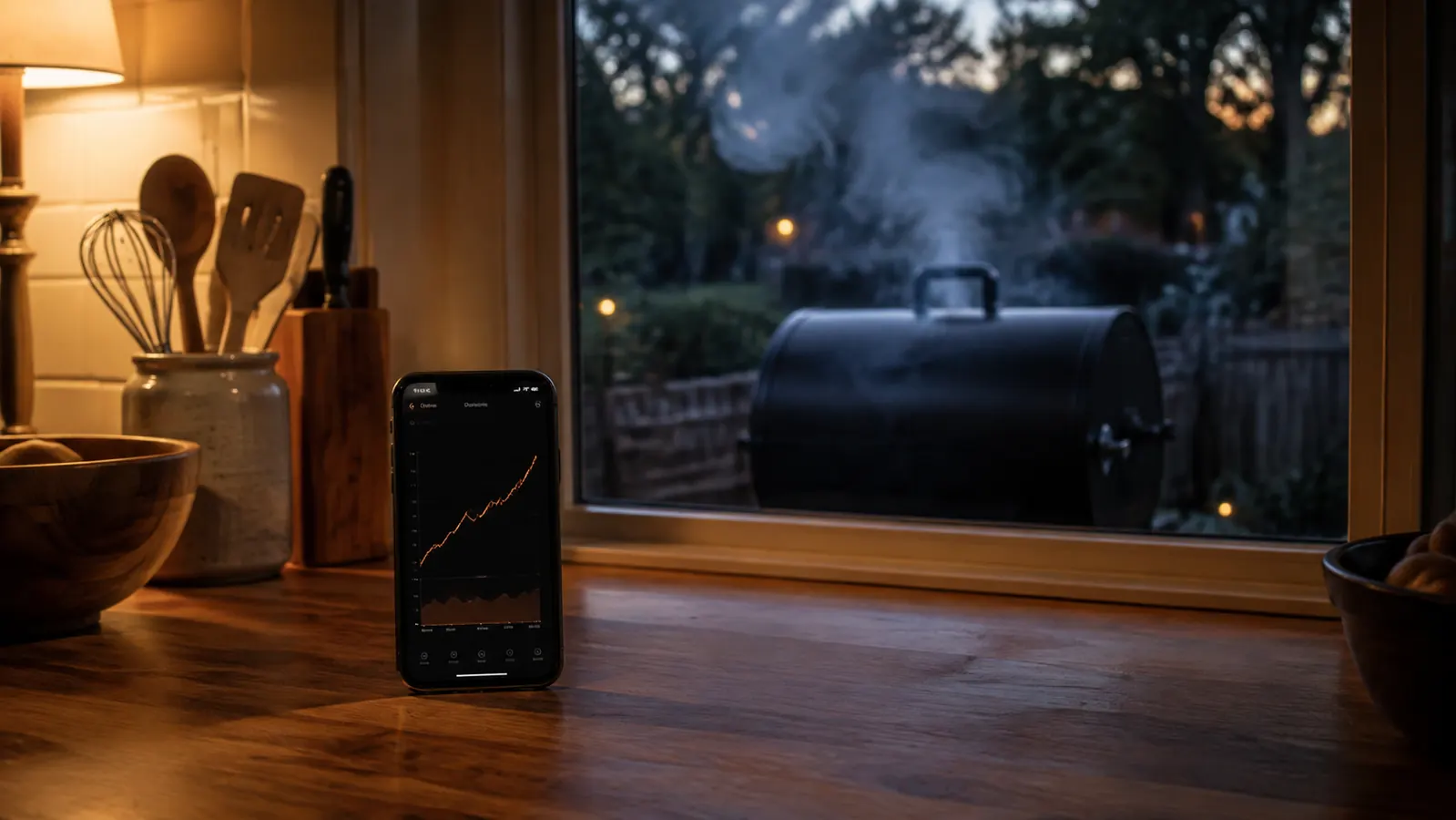
Step 4: Check the trend, not the number, and open the lid on schedule
This is the mental shift that saved my cooks: stop asking what the temperature is right now, and start asking which way it is moving and how fast. The app graphs both meat and ambient temperature across the whole cook, and the shape of that line is the real information. When the meat flattens out for two hours between 160 and 170, that is the stall, and the graph tells me it is normal instead of a dead fire. The old me would have cracked the lid, poked the vents and added a full chimney of fresh coals for no reason at all. On a good cook I check the app maybe four times an afternoon, and half those checks are just because I enjoy watching the numbers do their thing.
Decide in advance the only moments you are allowed to open the lid. On brisket mine are twice: once at the wrap, if I wrap, and once when I check probe tenderness before pulling. Everything else lives in the app. If a reading looks wrong, I trust the shape of the graph before I trust my worry. Nine times out of ten the pit dipped because a coal shifted, and the bottom vents fix that without me touching the lid. Deliberate opens are fine. Compulsive opens are what ruin bark.
Step 5: Trust the pull temp, then let the rest do the finishing
The hardest stretch of a long smoke is the ending, because the brisket is guaranteed to fool you right there. The MEATER app tracks temperature and estimated time left, and it recalculates after every stall. When the flat reads my target, 203 on this cook, I give it another fifteen to twenty minutes on the pit before I pull, because the center of the meat always trails the sensor a little. Then it goes straight into a tight wrap and rests in a cooler for at least two hours, and the graph shows me exactly where the temperature lands during that rest. That rest is where the connective tissue relaxes, and pulling early because you are hungry is the second-most-expensive mistake in BBQ.
The lid stays shut for all of it. My last fourteen-pound brisket went from loaded to resting with exactly two opens, one for the wrap and one to pull it, and the bark was the best I have turned out. It was also the easiest, because the fire never had to recover from my curiosity. If you want the long-term report on this probe, including the things it is genuinely bad at, my full MEATER Plus review covers a full year of cooks, and the unvarnished take lives in the honest MEATER Plus review.
What Else Helps
The probe does the heavy lifting, but a few cheap habits make the whole system bulletproof. A second, independent read of pit temperature, like a wired probe clipped to the grate, gives me a cross-check that Bluetooth cannot argue with, and it settles fights with my own patience. Calibrate the main probe twice a year in ice water, 32 degrees is the number, and clean the tip between cooks so it reads fast and true. Keep an eye on the charging base too, its battery is what feeds the probe, and top it up the night before a long cook.
And keep an instant-read thermometer for the moments the lid does come off. The wireless probe tells you when you are close, but a final check for probe-tender on the deckle is still worth the two seconds of heat you lose. Nothing in this workflow bans opening the lid. It just makes every open deliberate instead of compulsive, and that single change is quietly why every smoke I have run this year has turned out.
One more habit worth stealing: keep a one-line log for every long cook. Date, cut, pull temp, rest time, what the bark looked like. The graph in the app is the raw data, and a margin note turns it into a recipe you can repeat. The best brisket I cooked this year came straight out of three lines in that notebook, and the worst one taught me exactly which vent position not to trust.
I used to lose ten to fifteen degrees of pit heat every time I cracked the lid. My last brisket finished with exactly two planned opens, one for the wrap and one to pull it.
Stop cracking the lid and start trusting the number
A leave-in wireless probe like the MEATER Plus reads your meat and your pit at once and puts both on your phone. It changed my smoking more than any single grill upgrade I have made. Check today's price, read the honest review first, and decide for yourself.
Amazon Check Today's Price on Amazon →