
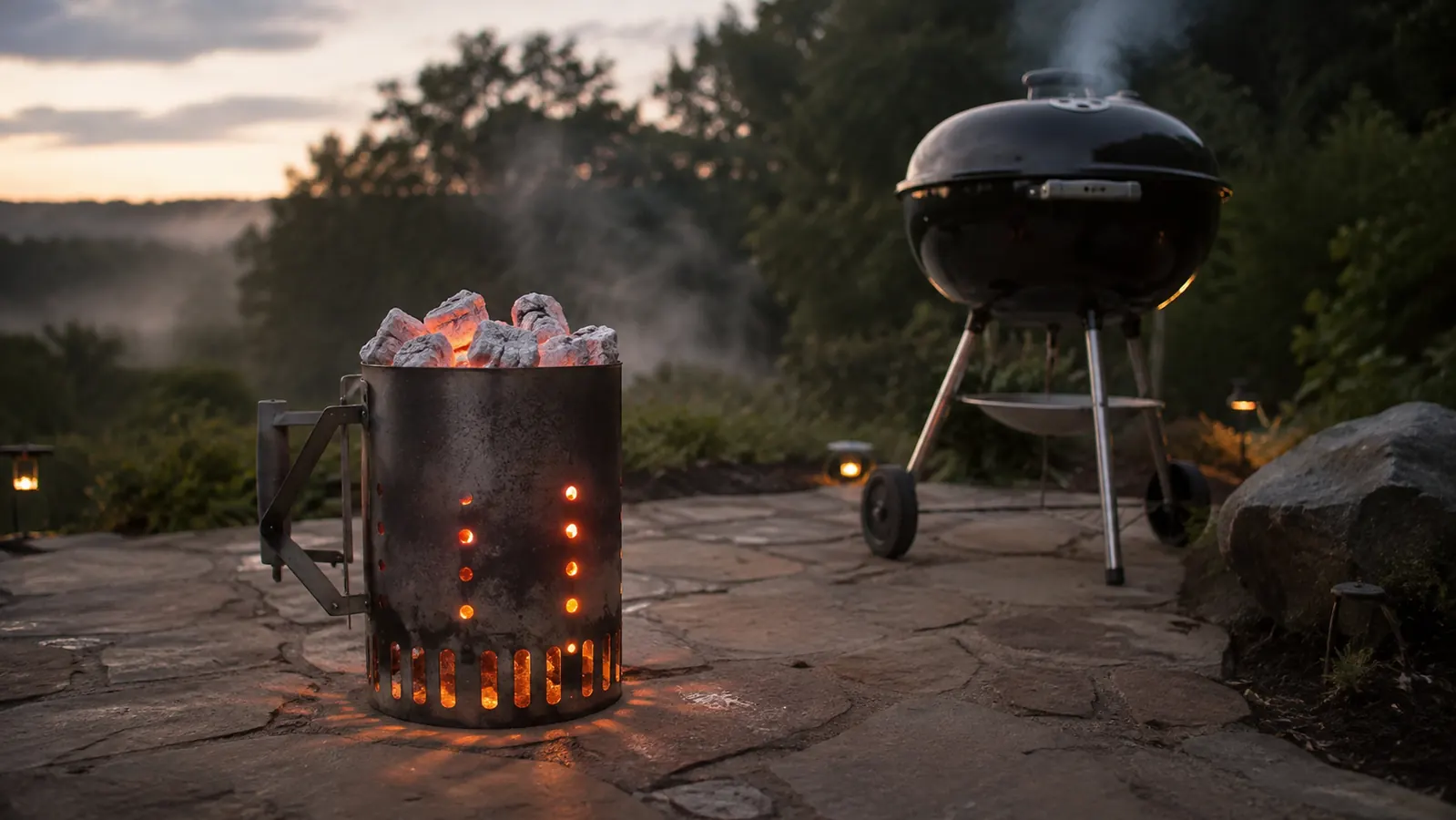
I still remember the first time I poured a chimney load onto the grate and realized what fifteen years of lighter fluid had been doing to my food. The problem was never that my charcoal would not light. It was that every method I used left a fingerprint. A squirt of fluid got briquettes glowing fast, then put a gasoline note through the first steaks of every cookout, no matter how long I waited for the flare to burn off. An electric loop starter needed an outlet near the grill, and mine sits at the back of the patio where the only power runs the landscape lights.
My neighbor two streets over cooks on a 1960s offset and showed me his Weber Rapidfire chimney starter on a foggy Saturday morning. I ordered mine that same afternoon. What follows is fourteen months and sixty-plus loads later, the long-term verdict on the most recommended charcoal accessory in existence, which is exactly why it deserved a skeptical test and not a fan letter. I kept notes the way I keep config files, because a tool this widely praised either earns the hype or it does not, and I wanted to find out which without anyone else standing in for my judgment.
The Quick Verdict
A full chimney of briquettes, ashed over and ready to pour, in about 20 minutes, with a handle that never gets more than warm. The lighter fluid went in the trash the week it arrived, and after sixty loads I would buy it again tomorrow.
Amazon Check Today's Price →Skip the Fluid, Skip the Wait, Skip the Chemical Taste
If your steaks still taste like the patio, the fix is not a different rub, it is how the coals get lit. This chimney has been the first thing I reach for on every charcoal cook for fourteen months.
Amazon Check Today's Price on Amazon →How I've Used It
Most of what has gone through this chimney is standard briquettes headed for a 22-inch Weber Kettle, the pairing most charcoal cooks will recognize. My season runs from early April through October, and I cook over real coals at least two nights a week in those months, more when the extended family shows up. The chimney has also handled lump charcoal for quick chicken sears, filled to the rim to get a Weber Smokey Mountain started for a twelve-hour brisket, and parked next to a second chimney on the busy cookout days when one load was not enough. On the Fourth of July I ran three loads in a single afternoon and never once thought back to the squirt bottle.
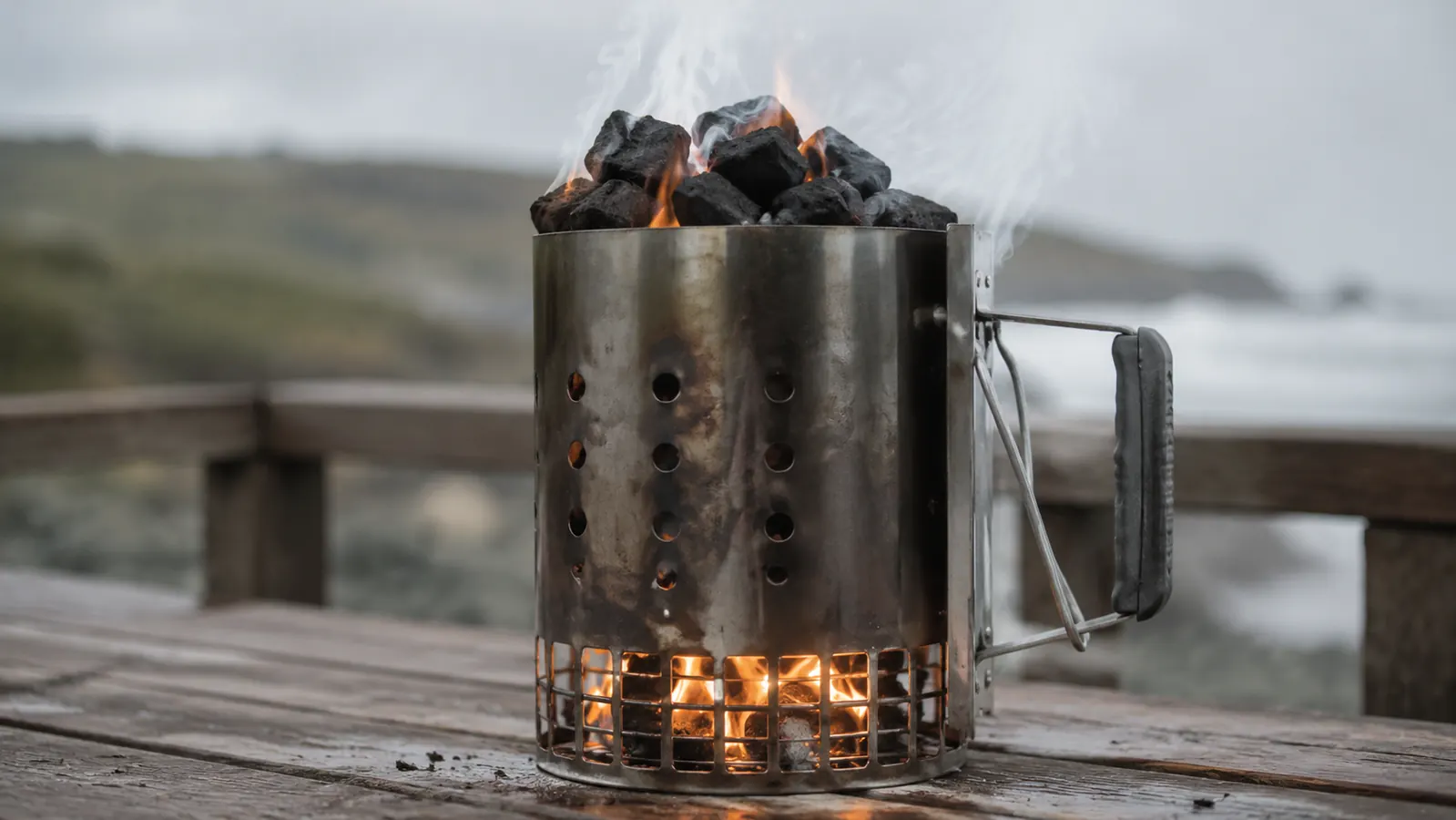
The routine is automatic now. Two sheets of newspaper, balled loosely and tucked under the interior wire grate, charcoal loaded to the top, the chimney set on the grill grate, one match through the side vents, then leave it alone. I timed it on ten separate mornings out of pure work habit, and the spread was tighter than I expected: 17 minutes on a still, dry day, 24 on a damp, breezy one, with most loads landing in the low 20s. When the top coals wear a gray ash coat and the ones visible through the vents are orange instead of black, the load is ready to pour. Every cook since the spring of last year has started this same way, and low as it sounds, that trust in the start is what lets me treat a weekday brisket as an option instead of an ordeal.
The payoff is speed you can schedule a dinner around. From the first match to 400-plus degrees on the kettle thermometer is right around 25 minutes, and I can have food on the table without the whole evening orbiting the fire. That consistency is what the fluid years never gave me, because a squirt bottle is judged by eye and gut, and mine was wrong more often than I cared to admit.
What Actually Makes the Rapidfire Worth Naming
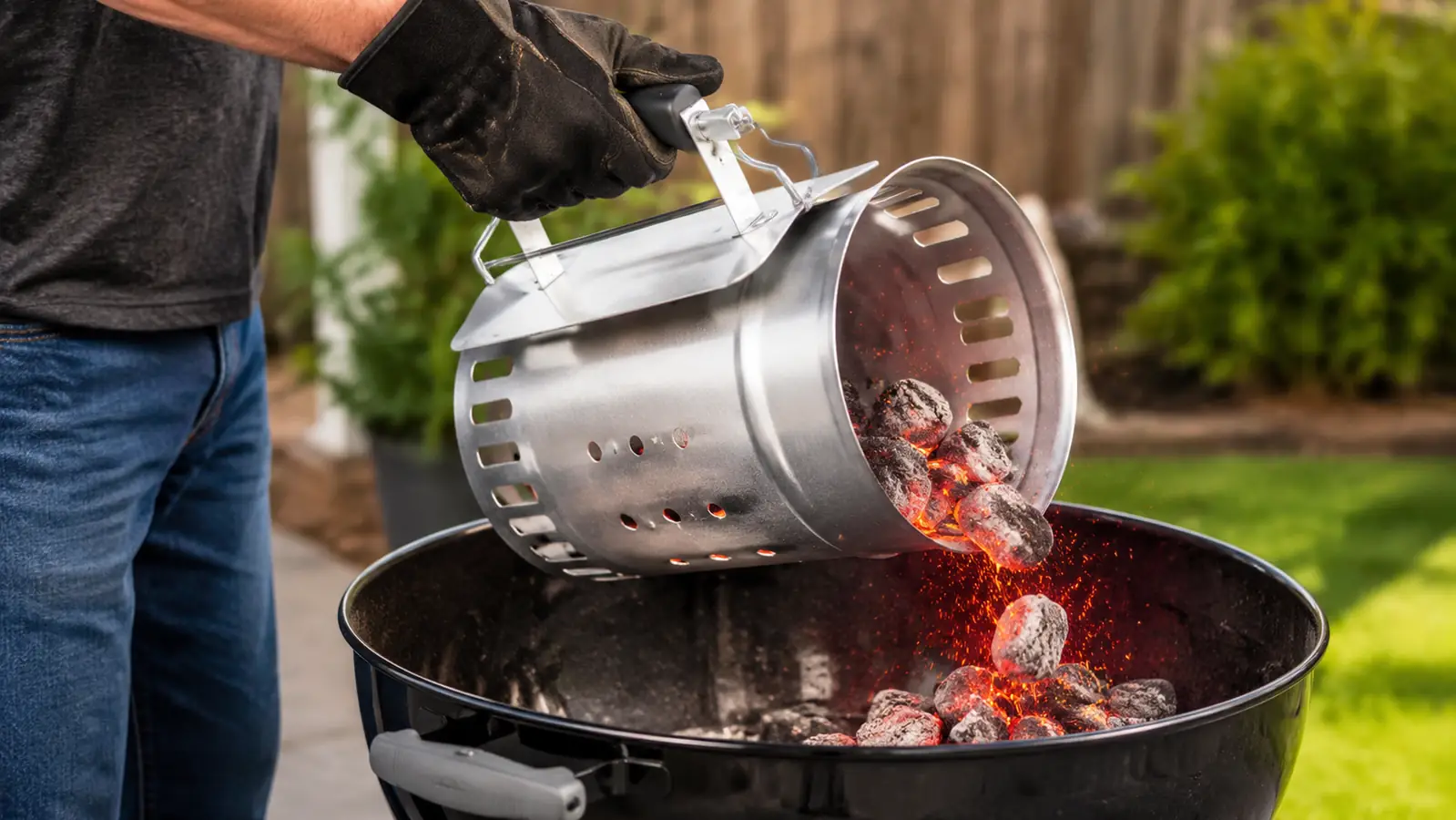
A chimney is a simple enough tool that the differences come down to a handful of details, and the Rapidfire gets the important ones right. The feature that separates it from the cheap knock-offs is the handle. A sheet-metal heat shield runs between your hand and the column of flame, so with a full load ashed over and roaring, I can pick the thing up one-handed without a glove. I have borrowed budget chimneys at cookouts, and every one of them needed two hands and a folded towel by the time the coals were ready.
The interior wire grate sits low enough that the newspaper has open air beneath it, which is the whole trick. A chimney is a draft column, not a bucket. The fire pulls air in from below, up through the coals, and the whole column catches at once instead of burning top-down. Get the airflow wrong on a cheap design and you get a chimney that smolders for 40 minutes and then tapers off. The Rapidfire's proportions mean the bottom layer is already collapsing into embers while the top layer is still catching, and the load pours out finished on the first tip. No second chimney shake, no coals that come out gray on one side and black on the other, which is exactly the finicky failure mode that used to send me back to the fluid.
In the standard size, a full load comes to a few generous layers of briquettes, which is the right amount for a 22-inch kettle and, with one refill, a full smoke. I have never wished it were bigger and never found the load skimpy. Weber also sells a larger version for people running big pits, and for anyone cooking on a garden-variety grill, the standard size is the honest fit.
Speed, and the Flavor Nobody Argues About
The reason most people buy this chimney is not the time, it is the taste. Lighter fluid is a blend of solvents that has to burn off completely before food touches the grate, and the ratio is easy to get wrong. Too little and the coals barely catch. Too much and the first half hour of the cook smells exactly like the fluid, and waiting longer does not fix a heavy hand, because the chemical burns off slowly while the coals lose heat at the same time. A chimney lights the paper only, and nothing volatile ever touches the food.
My wife noticed the difference before I said a word, which is the strongest evidence I have. She has never cared about the gear and never reads a label, and inside two weeks she asked why the steaks stopped tasting like the patio. That one unsolicited comment is the whole review, and it is the same story every chimney owner I know tells.
To put a number on it, I ran the same flank-steak test twice this past August to settle an argument with a coworker who swore his gas grill was just as good. Same marinade, same thickness, same resting window. The charcoal cook picked up the smoke ring and the mineral tang the gas one never touches, and the only thing the chimney changed was how the coals came to life in the first place. It is the kind of result that does not make it onto a marketing page but quietly decides the whole hobby.
There is also a logistics side that the marketing pictures skip. The chimney needs no outlet and no cord, so it works wherever the grill lives, which for me is at the back of the yard where the good smoke sits. I have thrown it in the truck for fire-pit nights and taken it on a camping weekend, and the only fuel it needs is the two sheets of newspaper. An electric starter is out of the picture the moment you leave the driveway, and that is before you factor in the extension cords.
Where It Bothers Me
No tool gets a long-term review without its annoyances, and the Rapidfire has three. The first is that it is bare metal with no cover of its own. Leave it out for a rainy week and it surface-rusts in patches, and the coating flakes around the rim after hard seasons. Mine lives in a plastic tote between cooks, which is a two-second habit, but it is a habit you have to keep, and keeping it is the entire story of how well this thing ages.
The second is the baked-in reality of a tool that lives around fire. It dings when you drop it, which I have done, and the heat shield gets a little rattly if you treat it like a hammer, which I have also done. None of it affects function, and I would rather own a tool that shows honest wear than one that pretends otherwise. The third is wind. On a genuinely breezy day the top of the column can lag the bottom, so I turn the chimney sideways to the breeze and the load pulls even again, which is a nudge, not a battle.
And the honesty clause, since this is a review and not a love letter: the chimney solves ignition and only ignition. You still have to bank the coals, manage the vents, and feed the fire through a long smoke. The Rapidfire gets every cook off to the same clean, consistent start and then leaves the rest to you, which is exactly the division of labor I want from a tool that costs what today's price is and asks nothing else of me.
The Alternatives I Tried
I have lit charcoal with fluid, with an electric loop, with a propane torch, and with a heat gun, and the chimney beats all four for the same reason: it is the only method that does not add energy or chemistry to the fuel. The propane torch got coals going fast but put me standing over a gas cylinder with an open flame on a foggy deck, which my sense of self-preservation eventually overruled. The electric starter needed a wall outlet and then still had to sit inside a chimney to do its job, at which point it is a chimney with extra steps and a cord.
I have also borrowed the no-name budget chimney more than once, and this is where the premium earns its keep. The cheap ones I have handled have thin bodies that radiate heat straight into the handle, wobble on uneven grates, and dent if you look at them sideways. The Rapidfire costs more by a visible margin, and in exchange you get the handle heat shield, a bottom grate that sits still, and a body that has held its shape through two hard seasons. That is a trade I make gladly, and it is the same honest trade I apply to every durable tool in the shed.
What I Liked
- Full load ashed over and ready to pour in about 20 minutes
- Handle heat shield stays cool, one-handed pour even at full roar
- No lighter fluid means no chemical taste, the reason most people buy it
- No cord or outlet needed, works at the back of the yard or a campsite
- Rugged build that has held its shape through two hard seasons
Where It Falls Short
- Bare metal rusts fast if left out in the weather, needs covered storage
- Coating flakes around the rim with hard use, dents are quick to earn
- A strong wind from the wrong direction can make the column burn uneven
- It only lights the fire, it does not manage the cook after that
Sixty-plus loads in, the only part I have ever replaced is the newspaper. The chimney still lights a full load in about 20 minutes, every time, in the fog.
Who This Is For
Buy the Weber Rapidfire if you cook on real charcoal more than a couple of times a month, on anything from a kettle to a kamado to a stick burner. Buy it if you have ever caught yourself waiting for the lighter-fluid smell to burn off before you dare put food on, or if you have skipped a midweek cook because getting the fire going felt like a project. It is the purchase that turns charcoal from a weekend production into a Tuesday-night option, and it costs a fraction of what one ruined steak dinner is worth. For my money it is the best-value upgrade in the whole charcoal drawer, sitting above even the nice tongs I bought the same month.
Who Should Skip It
Skip it if you cook on gas or pellets and do not own a charcoal grill, because the chimney has no job at your house. Skip it if charcoal comes out once or twice a year, where whatever lazy ritual you already have is fine and the extra dollars buy nothing. I would also steer it away from anyone who cannot be trusted to set a cylinder of live coals on a stable surface, because a tipped full chimney is a genuinely bad afternoon, and no handle design protects you from careless hands. You also need a dry corner to store the thing in, so if you have no covered spot at all, budget for the tote that comes with the habit.
The Last Bottle of Lighter Fluid Left My House the Week This Box Arrived
Fourteen months in, the Rapidfire is the first thing I reach for on every charcoal cook. If your steaks still taste like the patio, this is the durable, boring, correct fix, and the only running cost is two sheets of newspaper.
Amazon Check Today's Price on Amazon →