
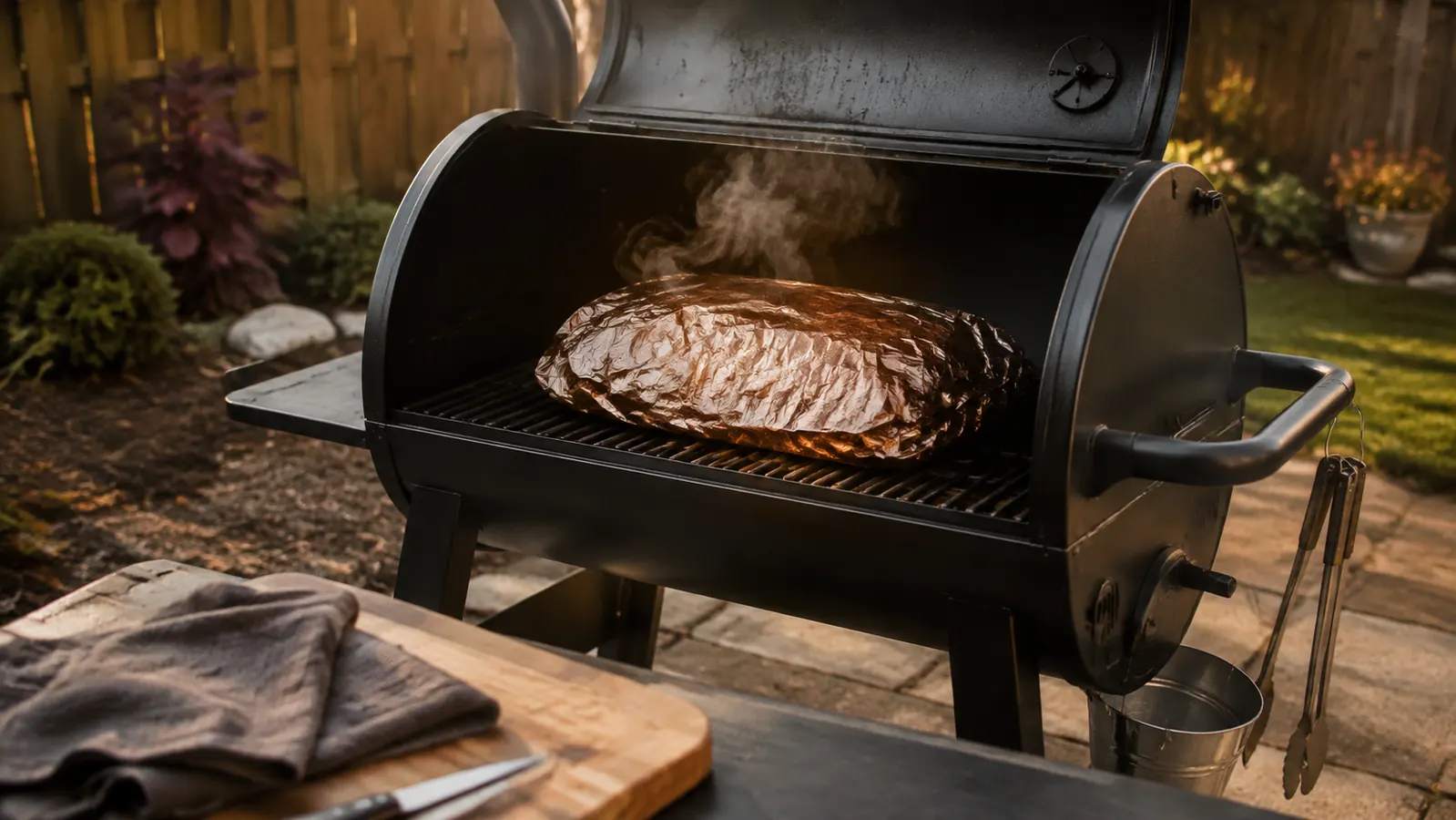
Every summer I watch the same near-miss at somebody's cookout. The brisket comes off the smoker at 200 degrees, dripping tallow, and the cook is balanced on one foot, yanking at pink butcher paper with one thin cotton mitt while the other hand hovers somewhere it should not be. That two-second grab is the highest-risk move in the whole craft of smoking. I have done it wrong myself, and I carry the proof on my right forearm where I clipped a grate before I knew better. The fix is not complicated: the right gloves and a practiced cradle, done the same way every time.
After three seasons with a pair of Grill Armor Gloves on my hands at the smoker, I can hoist a whole pork shoulder, grab a hot grate to reposition it, and lift a wrapped brisket off the grate without thinking about any of it. The technique matters as much as the gear. This is the exact sequence I use, the version I would walk a neighbor through at my own patio on a Saturday morning.
Before I moved to a real heat-rated glove, I cycled through a whole drawer of stand-ins: doubled-up terry towels, leather work gloves, one stretchy silicone-print mitt, and the two-second bare-hand grab when I convinced myself I was fast enough. Every one of those is how a burned forearm or a dropped dinner happens. A towel insulates once, then stays damp and carries heat straight through. Leather turns slick the second tallow touches it. You do not need a thicker towel or a quicker hand. You need a glove built for thermal contact with a wet, heavy load, and you put it on before the cook starts, not at the moment of truth.
Gloves with fingers end the scariest part of the cook
Grill Armor Gloves are EN407 certified and rated to 932°F, with a non-slip silicone palm and a cotton lining, so a heavy wrapped brisket stays firmly in your hands on the way to the board.
Amazon Check Today's Price on Amazon →Step 1: Put on gloves with fingers before you even light the fire
When I started smoking seriously, I grabbed briskets with the same quilted oven mitt I use for casserole dishes. It failed twice in one summer. The seams gave out where the thumb meets the palm, and the fabric carried heat straight through once it got wet, which a hot brisket is guaranteed to be. A cloth mitt is built for a dry dish, not a 16-pound wet load.
The pair I reach for now, Grill Armor Gloves, skips the mitten shape entirely. Each glove has fingers, so I can feel what my hands are doing under the paper, and the palm carries a non-slip silicone grip that holds slick butcher wrap without squeezing. They carry an EN407 heat rating good to 932°F and a cut-resistance rating that has saved me more than once on pork-shoulder bones. The cotton lining is the detail most people ignore; in cheap gloves the liner shifts and your hand swims inside at exactly the wrong moment.
Size matters more than price. I wear mine snug across the palm so the silicone grip stays in contact with whatever I am holding, and when they came out of the box I broke them in with a full chimney-lighting session before the first brisket. Three seasons in, mine have been through the wash half a dozen times, and the only real wear is on the right palm where it meets hot grates when I reposition the charcoal basket. That is honest wear, not failure.
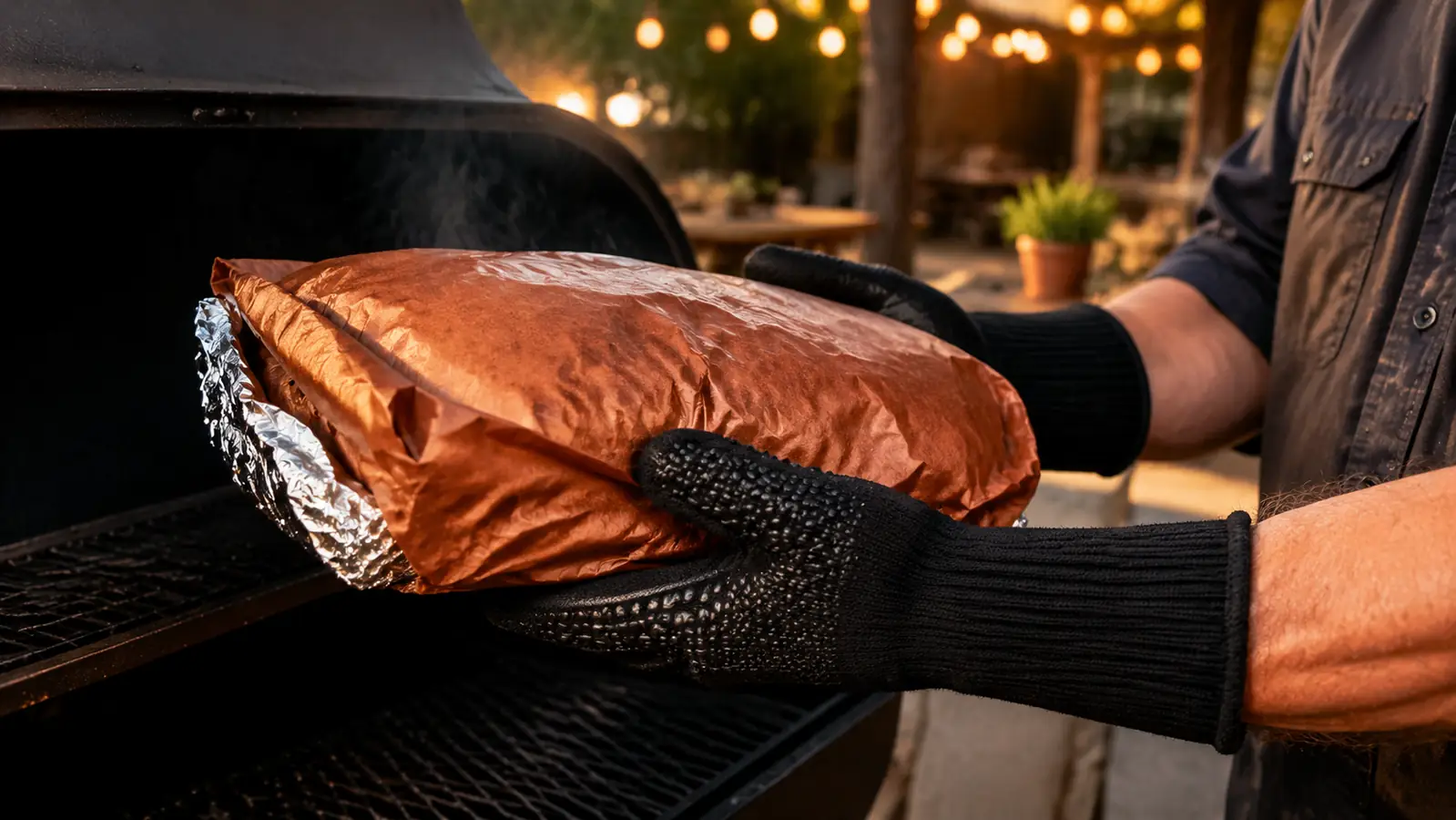
Step 2: Pull the brisket at probe-tender, not on the clock
I pull my brisket when the probe slides in like room-temperature butter, usually somewhere between 200 and 205 degrees at the thickest part of the point. On my last cook, a 14.5-pound prime packer from the warehouse store, that happened after 11 hours at 250, and it landed at 5:20 in the morning. The numbers matter here because a probe-tender brisket is fragile. The point will slump under a hard squeeze, and a brisket pulled early is stiff and awkward in your hands. Wait for the tenderness.
I rest mine in the wrap for at least 45 minutes before the lift. A rested brisket gives slightly, which makes it easier to cradle without tearing bark. If you are short on time, at least leave it wrapped on the counter while you set up the landing zone, which is the entire next step.
Here is what grabbing too early looks like. A brisket that has not finished rendering is stiff through the point, the wrap has pooled hot tallow in its folds, and the whole thing wants to twist out of your hands like a greased watermelon. You compensate by gripping harder, and gripping harder is exactly what steams you. Patience is genuinely a burns tool. If you are unsure whether it is probe-tender, poke it again; a probe that meets resistance means you would rather wait forty minutes than rush a lift.
Step 3: Build the landing zone before you touch the meat
The burns I have actually witnessed happen in the moment after a cook realizes the board is crowded. Clear the deck first. I put a big poly cutting board on a half-sheet pan, lay two layers of heavy foil on top, and set one folded kitchen towel next to it. The pan catches tallow, the foil keeps the board clean, and the towel dries a slick palm in one wipe.
I also make sure the road from the smoker to the board is obvious. No dog bed, no garden hose loop, no grandkid at ankle height. Both hands are committed for the next twenty seconds, and the path between them is the whole safety story. Twenty seconds of planning turns a scary lift into a boring routine.
One more landing-zone decision I make before the cook: what the brisket is wrapped in, and whether I lift it in the wrap. I wrap mine in pink butcher paper, and I lift it in that paper. Butcher paper holds together under a two-handed cradle and lets the bark breathe while it rests. Foil is slicker and hotter on the exterior, so if you cook foil-wrapped, give the foil ten minutes to set before you move the load, and keep the gloves on for the whole unwrap. The gloves come off only after the meat is on the board.
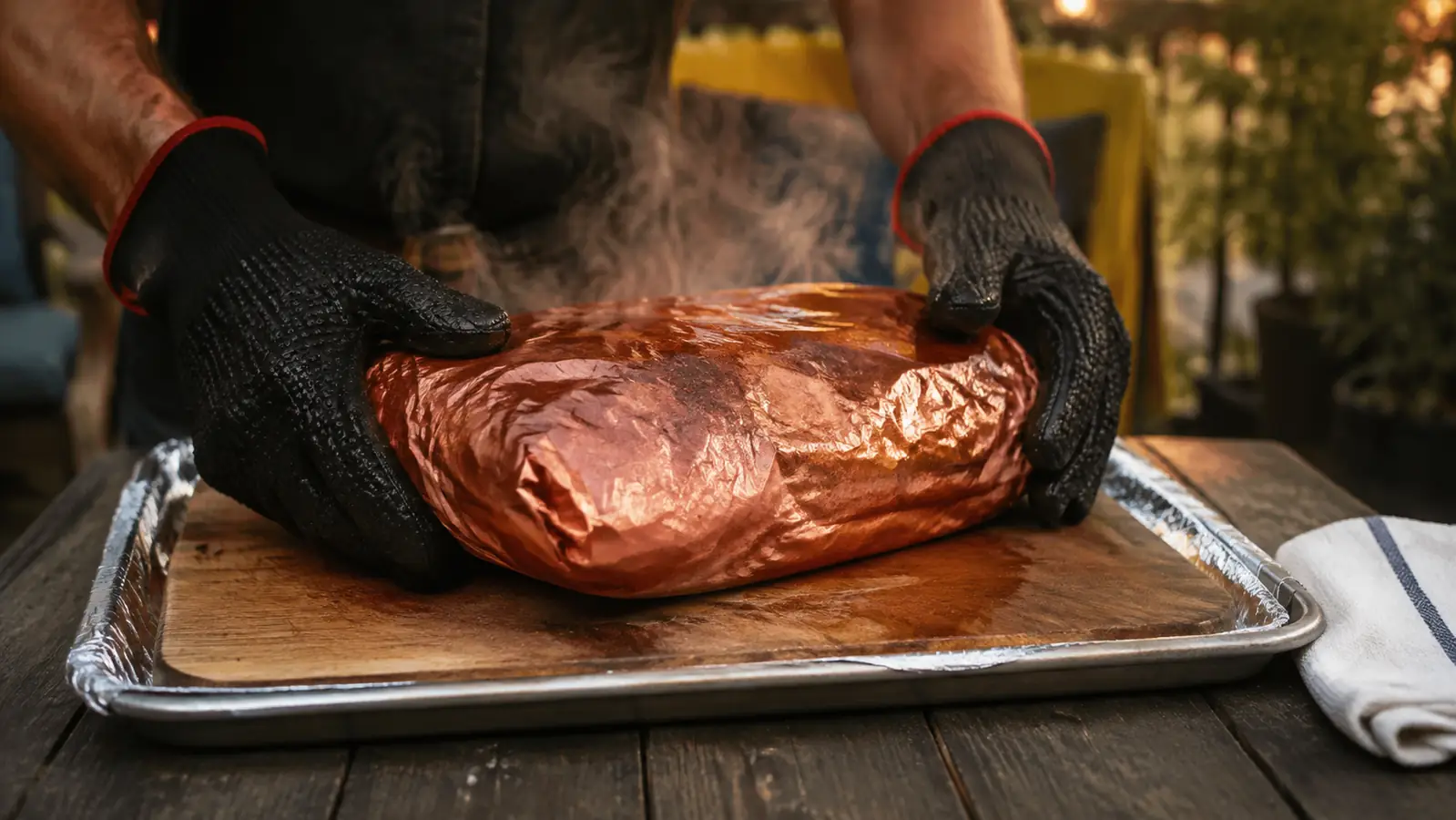
Step 4: Cradle both ends, do not squeeze the middle
Here is the actual grab. Stand facing the smoker with your feet about shoulder width, bend at the knees rather than the waist, and slide your dominant hand under the point end while your other hand slides under the flat. The brisket now rests across the full span of both palms, the weight sitting in the middle of the hands, not at the fingertips.
Two things keep you safe in that position. First, do not squeeze. A death grip compresses the brisket, pushes rendered tallow out through the paper, and the juice steams straight up between your fingers. The silicone palm on Grill Armor Gloves exists exactly so you can hold firmly with light pressure. Second, keep your wrists straight and your elbows in, and stand up with your legs. A 14.5-pound brisket plus wrap is close to 16 pounds, far too much to deadlift with your arms stretched out in front of you. Keep it cradled against your chest and lift with your thighs.
Both hands, every single time. One evening I ran low on patience and tried to lift the flat with one hand while reaching for the foil with the other, and a streak of hot grease found my wrist in the two seconds it took me to realize I was off balance. It healed in a couple of weeks. The lesson cost me nothing except a reminder that this step has no shortcut.
Take the lift in three beats so nothing is impulsive. Beat one: both hands are under the meat before anything moves. Beat two: you stand, keeping the brisket level, and bring it past the open smoker door without dragging it across the grate lip, which is the one surface that will smear tallow down the front cuff of the glove. Beat three: you are at the board. Fewer than ten seconds from grate to foil. Short, level, boring, done.
Step 5: Set it down by opening your hands, not tossing it
Move the brisket to the board the same way you lifted it, in a straight line, elbows in, no twisting at the waist. The counterintuitive part is the landing. People drop briskets by flicking the wrist at the last inch. Walk your palms down until the meat touches the foil, then open your fingers and ease your hands backward, out from under the load.
If the brisket needs a nudge to sit square, slide it with the flat of both palms instead of re-gripping. And keep the gloves on until it is parked. Once the meat is on the board, the dangerous part is over, and you can peel the gloves off and handle the paper with bare hands. That is the whole luxury these gloves buy you: you are never in a hurry while holding something hot.
If it starts to slip mid-transfer, do not grab with one hand. Drop both hands lower and wide, let the brisket re-seat across the palms, the way you would lower a sleeping child into a crib, keeping your hands underneath instead of clutching the sides. The moment it is on the foil, stop worrying about how it looks. A slightly shifted point end sits fine for a short rest and slices no differently. Preserving the bark is not worth a fresh burn five inches from your thumb.
You will grab the brisket again before the meal is over, when you rotate it on the board or lift the point to slice against the grain. Do not take the gloves off and then reach back in for the still-hot meat. Leave them on the counter within reach until the knife work is done, because the second grab is the one people forget. A warm, rendered brisket sheds tallow for a full hour, and every re-grip between grate and plate is the same lift you practiced on the way off the smoker.
What Else Helps
A good pair of gloves makes the grab safe, and two small habits make it routine. Keep a light aimed at the smoker; I do most of my long cooks overnight, and I learned the hard way that guesswork is not a reliable read on where your elbows are. And keep a second dry towel or a spare pair of gloves near the board, because the brisket wrap turns your palms slick with tallow a few minutes into the lift. On the enormous briskets, a wide spatula under one end or a second pair of hands makes the transfer a two-person job, and that is not cheating.
A headlamp genuinely belongs in the rotation. I strap mine on for every overnight cook, and being able to see the grate, the drip pan, and both of my own hands at 4 a.m. is half the reason the transfer feels calm. If you cook on a kettle where the grate sits low, add a short step stool so you lift from a standing position rather than a crouch, because a crouched lift turns your knees into a shelf for a hot load the moment your balance wobbles.
Do not squeeze the brisket. A death grip pushes rendered tallow out through the paper, and the juice steams straight up between your fingers.
To recap the whole routine in one breath: gloves with fingers go on before the fire, the brisket comes off probe-tender, the board is already set with foil and a towel, both hands cradle the flat and the point, and the landing is a gentle open-finger set-down. Run that sequence once and you will stop treating the transfer as an event. It becomes the ten quiet seconds between the smoke and the slice.
A pair of Grill Armor Gloves ends the scariest part of smoking
Fingers instead of mitts, a silicone palm that holds wet paper, and an EN407 rating for grate work. Grab a pair before your next overnight cook.
Amazon Check Today's Price on Amazon →