
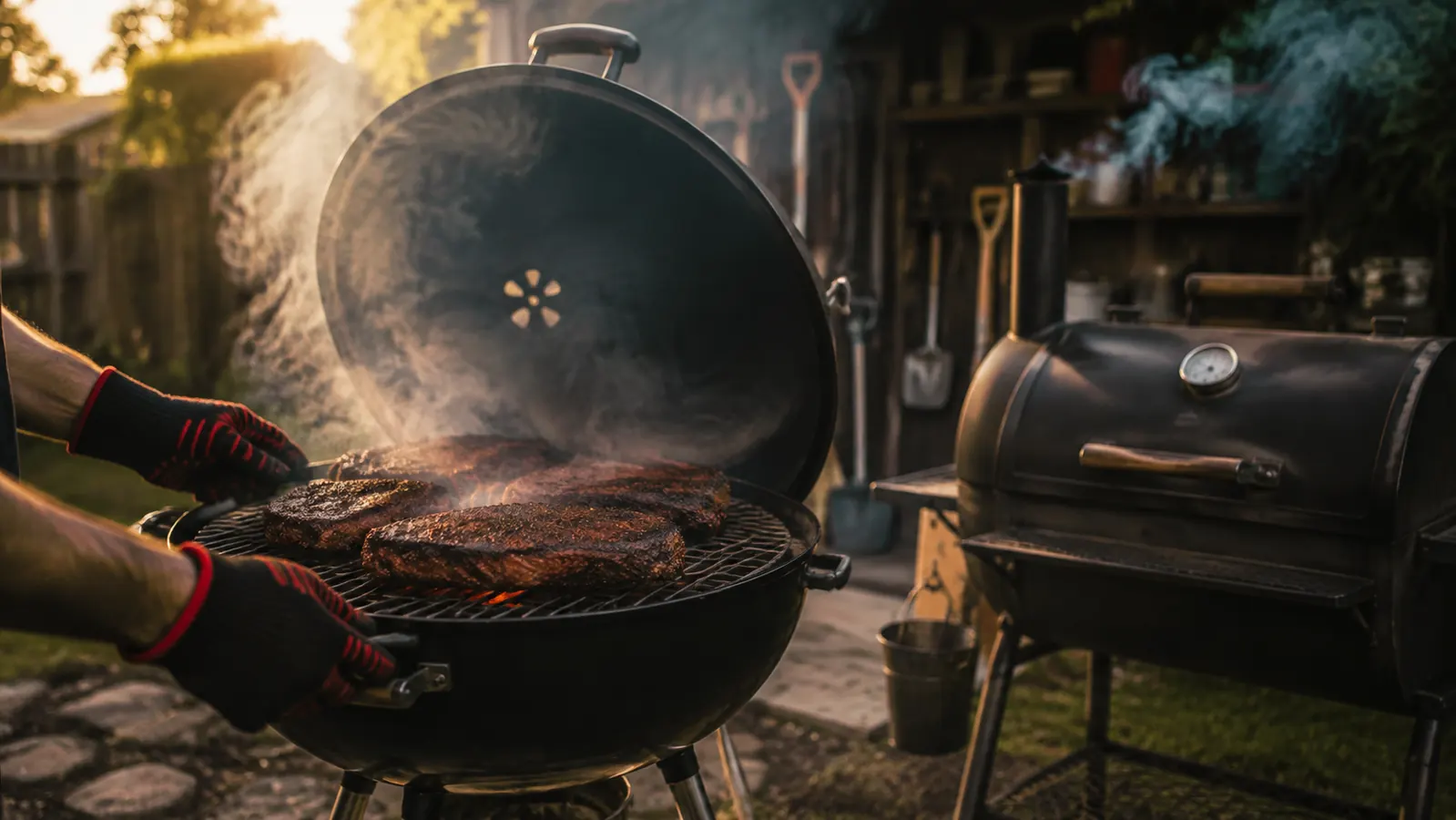
Every Grill Armor Gloves review starts with the number printed on the box, 932 degrees Fahrenheit, so let me start with the part the box does not print. In my first week I grabbed the rim of a chimney starter that had been roaring for twenty-five minutes, full of lump charcoal glowing orange at the top, and I felt nothing through the layers. That was eighteen months and one hundred plus cooks ago. Since then the same pair has lifted a 12-pound brisket off the smoker at 2 a.m., carried a dripping 9-pound pork shoulder across the yard in its foil, stirred a fire pit that had burned all evening, and seated a screaming-hot griddle grate in the sink. No burn has made it through. That is a longer and harder test than the sticker promises, and it is the reason I am writing this review at all.
Now the honest version, the one I wish someone had given me before my first pair of heat gloves. The 932 degree figure is a laboratory rating of the material, not a promise that you can clamp a piece of glowing metal in your hand for ten seconds and feel nothing. Squeeze hard, hold long, and the heat moves through, especially when the glove is wet. The silicone grip wears smooth at the fingertips first, the cotton lining stiffens if you ball the gloves up damp, and a hand that has been holding a leaking brisket spends the rest of the cook inside wet fabric. I still rate Grill Armor Gloves at the top of everything I have tried. But you are buying a high-dexterity heat shield for busy hands, not a welding gauntlet, and getting that line straight up front is the whole point of this review.
The Quick Verdict
The best all-around glove for hands-on grill, smoker, and fire pit work I have owned: real finger dexterity, honest heat protection for quick grabs, and cut resistance that has saved me twice at the knife block. Docked for the soggy-cotton reality of handling juicy meat and a silicone grip that wears before anything else.
Amazon Check Today's Price →The Pair That Survived Eighteen Months of Real Cooks
I have not bought a second pair since the day these arrived. Check today's price on Amazon and read the reviews from people who, like me, ran them through a full season before they gave their verdict.
Amazon Check Today's Price on Amazon →How I've Used Them
I work in IT, which means I buy gear the way I spec a network: I read the spec sheet, I stress it, and I keep running it for a year before I trust it. My rotation is a 22-inch Weber kettle for burgers and steaks, a compact smoker for overnight briskets and pork shoulders, and a fire pit out back that gets lit every evening the weather allows. The Grill Armor Gloves entered that rotation eighteen months ago, and they have not spent a single cookout back in the drawer since they arrived in spring.
The jobs pile up quickly once you trust them. Grabbing and seating hot grates, lifting a foil-wrapped brisket off the smoker in the dark, pulling a probe out with its tip still hot, stirring coals at the fire pit, carrying a full chimney of lit charcoal across a wet yard, scrubbing a hot griddle with a scouring pad, trimming brisket fat on the cutting board with a boning knife, and keeping my hands out of the business end of a rotisserie. I have also used them in the kitchen as oven gloves at Thanksgiving, which the ad copy never mentions, and honestly they are better oven gloves than most oven gloves being sold.
The honest measure is the everyday one: which glove you grab without thinking when the lid is off and the burgers are ready. For me it is these, more often than the tongs. But the same brisket lift that shows off the grip is also the test that exposes the soggy-cotton flaw, so in the sections below I am being exactly as specific about the bad part as I am about the good.
What the 932 Degree Number Actually Means
The product line leads with heat proof up to 932 degrees and EN407 certification, and I have learned to read that the way I read a network SLA: I hunt for the fine print. The rating comes from a laboratory reading of the glove material against a calibrated contact heat source. It is not a man standing over a kettle holding a white-hot grate in a firm grip while a photographer counts to ten. What you actually feel depends on how hard you squeeze, how long you hold, and a great deal on whether the glove is dry.
Here is what real cooks taught me. A quick, confident grab of a grill grate at five to six hundred degrees is completely comfortable. Lifting a chimney full of lit charcoal by the handle, comfortable. Seating a deflector plate in a 300-degree smoker, no problem at all. The moment to respect the number is the moment you would respect it bare-handed: holding metal in a tight grip for a long count, or touching something that is visibly glowing. When I slid a hot water pan out of the smoker and rested it on the edge to scoop, the pan was steam heat, not flame heat, and I could feel warmth climbing through after a few seconds. That is physics working at the edges of the rating, not a flaw in the product.
The genuine surprise is the cut resistance, which the product name buries behind the heat numbers. I trim a lot of briskets with a sharp boning knife, and twice the fiber layer has caught a slip that would have ended my evening at the sink. If you trim, debone, or sharpen while wearing gloves, that quiet feature may be the one you come to rely on most of all.
The Juice Problem Nobody Puts in the Title
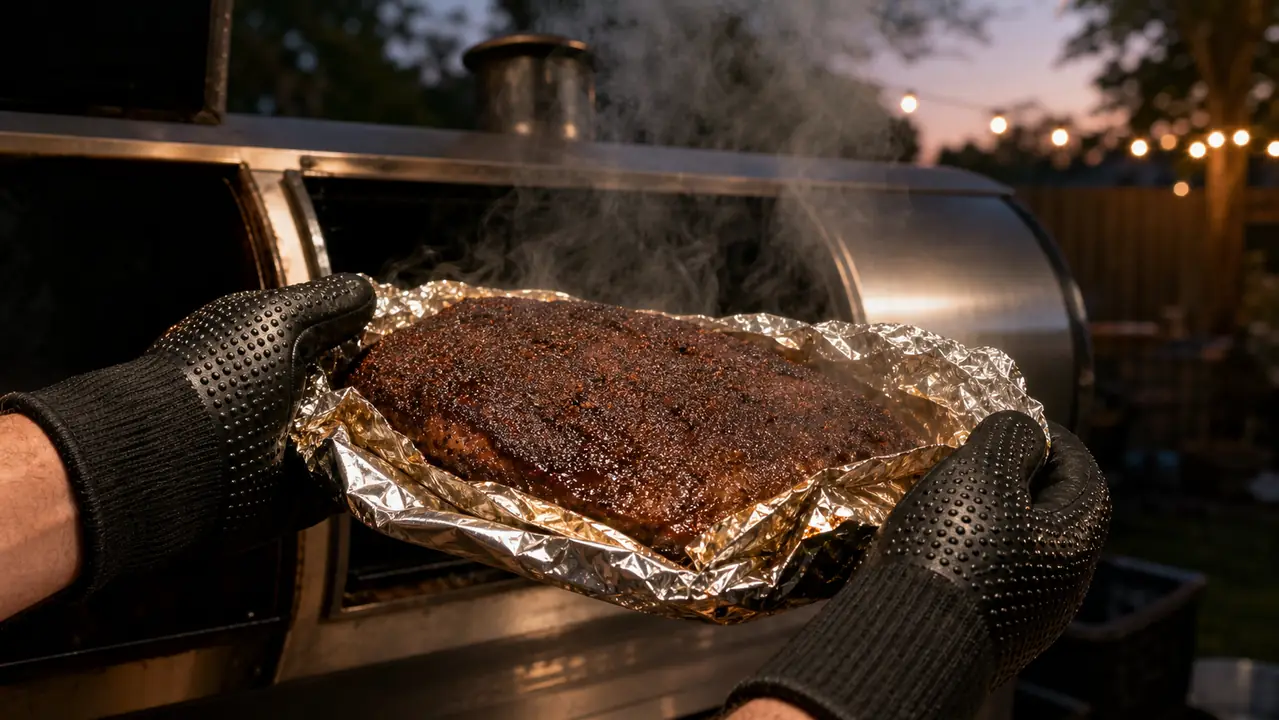
Let me be blunt about the most disappointing moment of the whole year, because nearly every glowing review leaves it out. You pull a pork shoulder that has smoked for twelve hours, wrap it in foil, and lift it onto the cutting board. It is glorious, heavy, dripping, and well past 200 degrees on the surface. The gloves stop the heat from the foil, they protect your hands from the steam when you tear it open, and the silicone grip means you never almost drop it. And then the juice runs down your wrist inside the liner, and for the rest of that cook you are standing at the board in wet, warm fabric while the meat shreds perfectly in front of you.
I have learned to live with it. I fold the cuff over, or tuck a paper towel under it, or complete the lift and then pull the gloves off to dry while I work. A friend who caters runs thin vinyl gloves underneath for exactly this reason, and that is the best trick I have picked up all year, even if it will never make it onto the box. The lesson is that wet, greasy, long-duration work is not what any cloth glove is for. The same glove that is a joy in dry service needs a different approach when the juices are running, and knowing that is the difference between a review that praises and one that informs.
For the dry and brief contact that honestly makes up about 80 percent of grill work, the gloves are near perfect. Burgers on, burgers off, grate seating, chimney handling, fire pit tending. None of those jobs involve a quart of rendered fat. On all of them the Grill Armor Gloves walk straight over every cookie mitt I have owned in thirty years of cooking outside.
A Season of Washes: What Wears First
I wash these by hand in the sink with mild soap after nearly every cook, because brisket juice and campfire ash have no business meeting the next cook's food. Eighteen months in, the outside still looks like a work glove should: honest staining, no rips, nothing separating. The silicone grip on the palm and fingers is the very first thing to show wear. Around the one-year mark I noticed the diamond pattern at the fingertips and the heel of the palm smoothing out, and the grip on the grate bars is a little softer than it was new. It has not failed, but it is the part to watch.
The cotton lining is a more honest story. Dry, it is breathable and comfortable, and these are the rare heat gloves that do not turn your hands into rain in July. But a 12-pound brisket leaking rendered juice pushes the lining, and a wet cotton lining is a different thing: heavier, clingier, and it lets the wrong kind of warmth climb down to your knuckles. I drape them over the kettle handle in the sun and they come back dry and fine every time. Treat them like dish towels, balled up wet in a drawer, and they stiffen up and go rough.
The seams at the cuff are the other honest note. The edge where the fiber and the cotton meet slides against your wrist every time you pull a glove on, and after heavy use there is a spot on my left cuff where the weave is loosening into a small fray. It is cosmetic. It has not grown into a hole in a year and a half, and most people will replace the whole pair for other reasons long before they reach that. But no cloth glove is buy-it-for-life gear, and any review that calls these indestructible is selling instead of reviewing.
And give each glove a dry spot to live between cooks. Mine sit on two prongs of a utility hook screwed into the side of the smoker cart, where the morning sun reaches them by nine. That leaves the cotton lining open to the air and dry instead of balled up damp at the bottom of a drawer, which is the fastest way to ruin a cotton liner. Eighteen months of that routine and the lining still feels the way it did the afternoon the pair arrived.

Where They Genuinely Choke
The honest list of jobs where I reach for something else. Fine motor work first: tying butchers twine on a roast, or fishing a loose screw out of the ash bucket. The gloves give you five real fingers, but five gloved fingers are still thicker than five bare ones, and I take them off for delicate work every time. Reaching deep into a hot kamado to fit a smoking chunk is fine, but holding a piece of hot metal in a clamped grip for minutes while people chat? Not the tool for that, and the rating does not cover it. A cast pan handle that has been next to a big flame for a while gets a quick touch from me, not a death grip, because quick is exactly what the rating covers.
And for clearing brush or feeding a wood stove all afternoon, I still grab my leather gloves from the shed. That is a different job with a different heat profile, and the Grill Armor Gloves are not the best tool for it. Knowing where a tool ends is exactly why this pair has made it eighteen months without being thrown across the yard in frustration.
Sizing, Fit, and the First Week
Getting the right size is most of the battle, and it is the one thing the listing will not settle for you. I wear a large in most work gloves, and the large fits like a good work glove should: snug across the palm, a little room at the fingertips, no loose fabric flopping at the cuff. A buddy who runs a catering counter bought one size up on purpose so he could add a thin liner underneath on cold-weather smoker days, and it works for him because he planned for the extra layer. What never works is bumping up a size to feel safe and losing the fingertip feel, because that fingertip feel is the entire reason this shape beats a cloth mitt. Measure your hand exactly as you would for leather and trust the size you actually are.
Expect a clumsy first week and try not to judge anything during it. You sight a grate bar that has been hot for a while and your body braces for a shock that never arrives, so you grip harder than the job asks. Give the silicone palm a few real cooks before you judge it, because it is more grippy than it looks once you stop over-gripping. By the second week the pair comes on without a thought and you grab a chimney rim or lift a full foil pan like a third hand, and that is the moment the Grill Armor Gloves stopped being a new gadget and became the default. Nothing in the months since has changed how often I reach for them.
What I Liked
- Real five-finger dexterity: you can grip a grate bar, a foil edge, or a chimney handle precisely
- Honest heat protection for quick everyday grabs, including a roaring chimney starter
- Cut-resistance layer that has saved me twice at the knife block
- Non-slip silicone grip that makes heavy, greasy loads feel safe
- Breathable cotton lining that stays comfortable in humid summer air when dry
- Wash by hand and they come back clean after a season of use
Where It Falls Short
- The 932 figure is a contact rating, not a license to clamp glowing metal for long counts
- Wet and juicy cooks soak the cotton lining; your hands finish the cook damp
- Silicone grip pattern smooths out at the fingertips after about a year
- Sustained radiant work, like a blazing fire pit turn, moves back towards leather
- Fine motor tasks like tying twine are still clumsy through the fibers
Eighteen months, a hundred chimney grabs, and dozens of 2 a.m. brisket pulls: a real burn has never once made it through these gloves.
Who This Is For
If you cook at a grill or smoker more than once a week, if you have ever held a folded towel against a grate because a cloth mitt would not reach, if you have a fire pit you actually light, if you trim your own meat, or if a single hot-grate slip has already cost you a week of uncomfortable hands, these gloves are for you. This is the crowd that touches its food and its fire instead of poking both at arm's length with tongs. If that is you, I would rather send you to today's price on the pair I actually own than watch you buy a third set of mitts out of habit.
I am also a buyer who researches almost every purchase and lays three or four options side by side before committing, and my honest verdict after a year and a half is that I chose these for the tactile control and the cut layer, not for the number on the box. Nothing since has made me wish I had gone a different route.
Who Should Skip It
Skip them if you grill once a month in good weather and every task fits on a plate carried with towels. Skip them if you genuinely need protection from sustained radiant heat, the world of forge work, welding, or a wood stove that runs all afternoon. That is a different job and requires a different class of gear. And skip them if you will never wash cloth gloves by hand, because a cotton liner left wet in a drawer feels amazing, and no heat rating can fix that. For those buyers, my honest advice is to save your money for something you will actually use.
The Pair I Reach for When the Smoke Is Up
Eighteen months of real cooks and I have not replaced this pair once. That is the only durability review that matters. Check today's price on Amazon, skim the honest reviews, and then you will know exactly what the pair you get will stand up to.
Amazon Check Today's Price on Amazon →